A Beginner's Guide to McLaren Car History

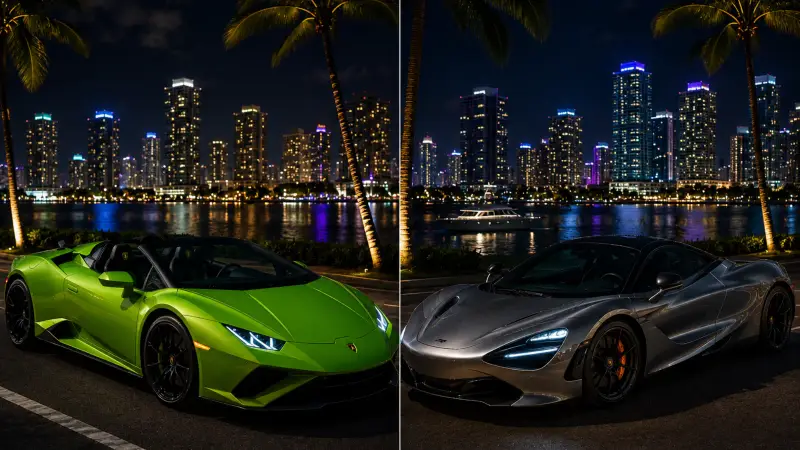
You see it before you hear it, which is unusual for a car this fast. Low and quiet, it slides along a Miami street on a Saturday evening, catching the last of the light without shouting for it. Someone at the valet stand turns their head. Someone else pulls out a phone. And almost every time, the same question surfaces from a bystander who clearly knows their exotics but cannot quite place this one: "Wait, who makes that?"
Want the engineering side? Read how McLaren's F1 team shapes its road cars.
That question is exactly what this piece answers. If you are just getting curious about the brand with the swooping silhouette and the doors that open toward the sky, you are in the right place. The honest, useful version of McLaren car history starts with a simple idea that explains almost everything about the cars: McLaren is a racing team first and a road-car maker second. That order is not a footnote. It is the whole story. This is a story and identity piece, not a sales pitch, so settle in. By the end you will understand not just who makes these cars, but why they feel the way they feel.
Who Is McLaren? The Short Version Before the Story
For total beginners, here is the quick orientation. McLaren is a British marque with deep roots in motorsport. Today the name covers two connected but distinct operations. There is the racing side, best known for competing at the highest level of open-wheel racing. And there is McLaren Automotive, the road-car company that designs and builds the machines you can actually own, register, and drive on public roads.
So when people ask who makes McLaren cars, the precise answer is McLaren Automotive. But the fuller answer requires the racing history, because the road-car company was born from it and still borrows its thinking from it every single day.
Here is the arc we will follow. First, the man. Then the racing team he founded. Then the original road car that set the template. Then the modern road-car company. And finally, the through-line that ties all of it together: racing DNA that shows up in metal, carbon fiber, and the way the steering talks to your hands.
The Man Behind the Marque: Bruce McLaren
Before there was a badge, there was Bruce McLaren, a racing driver and engineer from New Zealand. He founded his racing team in 1963, and the marque still carries his name and, arguably, his temperament.
What made Bruce unusual was that he was two things at once. He was a genuinely gifted driver who competed at the top of the sport, and he was a builder who understood the machinery underneath him. Plenty of drivers can go fast. Fewer can look at a car, understand why it is slow through a corner, and then engineer the fix. Bruce could do both, and that combination shaped the culture of the company from the beginning. It was a team run by people who wanted to understand the car, not just pilot it.
Bruce died in 1970 during testing at Goodwood in England, a loss that could easily have ended the young operation. Many teams built around a single founder simply fade once that person is gone. That is the part of the story worth sitting with: McLaren did not fade. The team endured, and then it grew, carrying forward the standards Bruce had set rather than drifting away from them. The legacy became bigger than the man, which is rare and says something about how strongly the foundations were laid.
A Founder's Philosophy That Still Shows Up in the Cars
Bruce's approach was engineering-first, obsessed with saving weight, and always focused on the driver. He believed a fast car was one built with discipline, not one loaded with more of everything. Lighter, stiffer, cleaner, more direct.
Hold onto that idea, because it is the single most useful thing to know before we get to the modern road cars. Decades later, long after Bruce was gone, you can still trace his fingerprints across the lineup. When we get to the section on what makes a McLaren feel like a McLaren, you will recognize this philosophy immediately. The founder set a template, and the company has spent its entire life refusing to abandon it.
The Formula 1 Legacy Comes First
To understand the road cars, you have to respect the racing. The McLaren F1 team stands as one of the most successful operations in the history of Formula 1. We are talking about decades of competition at the sport's highest level, with championship-winning eras that put the name among the sport's true institutions.
It is worth being measured here rather than reeling off numbers that get argued over. The point is not a specific tally. The point is longevity and excellence sustained over a very long time, through changing eras, engineers, and drivers. That kind of consistency is not luck. It is culture.
For most casual fans, the reference point that lands hardest is the late 1980s, when Ayrton Senna and Alain Prost drove for the team. That pairing produced some of the most talked-about racing of the era, two extraordinary drivers competing at the front, often against each other. If you know one thing about McLaren's racing history before reading this, it is probably that. And it is a fair place to anchor, because it represents the team operating at the very peak of the sport.
Why the Racing Matters for a Road-Car Buyer
Here is where the dots connect, and it is the most important idea in the whole article. Racing is a brutal, unforgiving teacher. On a track, weight is the enemy, aerodynamics decide races, and a component that fails under stress ends your afternoon. To win, a team has to master lightweight construction, airflow, materials like carbon fiber, and reliability under real punishment.
Now imagine taking that exact toolkit and pointing it at a car meant for a public road. That is essentially what McLaren does. The lessons learned chasing lap times, the disciplines that keep a race car alive at speed, become the design principles for the road cars. Track DNA becomes road-car DNA. This is not a marketing language. It is a genuine engineering lineage, and it explains why a McLaren tends to feel precise and purposeful rather than merely powerful.
The McLaren F1: The Road Car That Defined Everything (1992)
In 1992, the company built the car that would define its road-going identity forever: the original McLaren F1. And yes, the naming is confusing, so let us clear it up right away. The McLaren F1 road car is a car you can own. The McLaren F1 team is the racing operation. Same name, two different things.
The F1 road car was, and in many ways still is, extraordinary. It used a three-seat layout with the driver positioned in the center and a passenger tucked slightly back on each side. It was built around a carbon-fiber monocoque, a lightweight and immensely strong structural core borrowed directly from racing thinking. At the time this was almost unheard of in a road car. And when it arrived, it earned its place among the most significant hypercars ever made, setting speed benchmarks that stood for years.
But the specifications are almost beside the point. What matters is the philosophy the F1 broadcasts to the world. No compromise. Obsessive weight-saving. Engineering purity chosen over decoration and flash. The car did not try to impress you with excess. It tried to be the purest possible expression of how a fast car should be built. That mission statement became the template every later McLaren road car would follow, and it is the reason the brand feels the way it does today.
The Modern Era: McLaren Automotive from 2010 Onward
For a long stretch after the original F1, McLaren was primarily a racing company again. The modern chapter of road cars begins around 2010, when McLaren Automotive launched as a dedicated road-car company. This is a key distinction to hold onto. The road-car business is its own operation, separate from the F1 team, though it shares the same heritage and the same engineering instincts.
From there, the story of McLaren's road cars becomes a series of clear milestones. The 12C arrived as the modern comeback, the car that proved McLaren could build a competitive contemporary supercar and not just a legendary one-off. It was followed by more attainable entries like the 570S and 540C, which brought the brand within reach of a broader group of enthusiasts. Then came the 720S, widely praised by drivers and press alike, a car that many consider one of the sharpest all-around supercars of its generation.
Notice the progression. Comeback, accessibility, and then a genuinely celebrated high point. In roughly a decade, a road-car company went from restarting to earning real respect. That is fast, and it tells you the racing culture translated well.
How the Lineup Is Organized (Made Simple)
McLaren has generally organized its cars into tiers, and once you understand the logic it becomes easy to place any model you come across.
At the accessible end sits the Sports Series, the most usable and daily-friendly cars in the range. These are the ones most likely to be someone's first McLaren. In the middle is the Super Series, the sharper performance core of the brand, where the engineering really shows its teeth. And at the very top is the Ultimate Series, the rare halo cars produced in tiny numbers, the modern spiritual descendants of that original 1992 F1.
One caveat, and it is an important one. These lineup names and models evolve over time. Manufacturers rename tiers, retire models, and introduce new ones. So rather than memorizing a snapshot that may be outdated by the time you read it, use the tier logic as a mental map and always check current models for what is actually available now. The framework lasts. The specific names do not.
What Makes a McLaren Feel Like a McLaren
Here is the payoff. Across nearly every model, certain signatures repeat. These are the traits that make the brand recognizable to people who know cars, and they all trace back to the philosophy we have been building toward.
The Carbon Fiber Tub as Standard
Most exotic manufacturers reserve full carbon-fiber construction for their most expensive halo models. McLaren tends to build its cars around a carbon monocoque, sometimes called a tub, across the lineup rather than only at the top.
In plain terms, a carbon tub is a lightweight, extremely stiff structural core. Light means agile and efficient. Stiff means the car responds precisely and predictably. Having this kind of structure available broadly, rather than only on the rarest cars, is unusual, and it is a direct expression of Bruce's lightweight-first thinking. The founder wanted less weight. The company built its whole modern range around a way to deliver exactly that.
Mid-Engine Layout and Steering Feel
McLaren road cars are typically mid-engined, meaning the engine sits behind the driver and ahead of the rear axle. This placement puts the car's mass toward the center, which helps balance and gives the car a planted, agile character through corners.
The other hallmark enthusiasts talk about endlessly is steering feel, and McLaren has favored hydraulic steering, which many drivers prize for the way it communicates. "Feel" sounds vague until you experience it. It is the sense that the car is telling your hands what the front tires are doing, moment to moment. When you can feel the road that clearly, driving becomes a conversation rather than a series of guesses. That connection is central to what makes these cars satisfying, and it is why McLaren shows up so often in conversations about the best-driving sports cars.
Dihedral Doors and Restrained, Functional Design
The one bit of theater McLaren allows itself is the doors. They open upward and outward in a signature dihedral motion, and it is genuinely dramatic every time. Beyond that flourish, the design language stays clean, aerodynamic, and function-led. Shapes exist because airflow or cooling or downforce demands them, not purely for decoration.
This is a matter of design intent, not superiority, and it is worth framing carefully. Brands like Ferrari and Lamborghini often embrace a more overtly flamboyant, emotional visual approach, and that expressiveness is a huge part of their appeal and their heritage. McLaren simply pursues a different philosophy, one where form follows function and the drama is dialed back. Neither approach is better. They are different tastes for different buyers, and the exotic world is richer for having both.
Lightweight Over Brute Force
If you distill everything into one sentence, it is this. McLaren tends to chase balance, agility, and efficiency of engineering rather than raw spectacle alone. Other cars may win on outright drama or a bigger headline number. McLaren's instinct is to make the whole package lighter and more precise so it does more with less.
So is a McLaren a good car? The honest answer is that it depends entirely on what you value. If you value engineering discipline, driver connection, and a machine that feels sharpened rather than merely powerful, McLaren optimizes for exactly those things. That is not the only way to be great, but it is a genuinely coherent and admirable one.
Where McLaren Fits Among the Greats
A balanced view serves you better than a cheerleading one. The strengths are real. McLaren excels at driver engagement, engineering purity, and a kind of exclusivity that comes naturally from lower production numbers. You see fewer of them, and the ones you see feel deliberately built.
The honest context matters too, and none of it is negative so much as worth knowing. As a road-car company, McLaren is younger than several storied marques, which means less decades-deep road-car heritage even if the racing pedigree runs long. The dealer and service footprint is smaller than that of larger, older manufacturers, something to factor in depending on where you live. And the clinical, restrained styling that many people adore genuinely is not for everyone. Some buyers want more visual drama, and that is a completely valid preference.
Present all of this as trade-offs, because that is what they are. A curious reader deserves the full picture, and understanding the trade-offs is how you decide whether the brand's priorities line up with yours.
Why McLaren Resonates in Miami
Miami is saturated with exotics. On a busy night you can lose count of the supercars idling outside a restaurant on Ocean Drive. In that environment, standing out is harder than it sounds, and that is precisely why a McLaren works so well here. Because it is less common than some rivals, it registers differently. It is the car that makes even a jaded local look twice.
Picture one sitting low on Collins Avenue at dusk, or gliding through Brickell between the glass towers with the doors doing their upward dance when it stops. It has presence without needing volume. That is the appeal for a certain kind of person, the one who wants to be noticed by people who actually know cars rather than simply by the loudest bystander. Quiet confidence over noise. In a city that often rewards the opposite, that restraint reads as taste.
If the brand has caught your attention, you can see how McLaren fits into the wider exotic landscape on the McLaren brand page.
How to Experience a McLaren in South Florida (Without Owning One)
Here is the encouraging truth. You do not have to buy one to understand what this story is about. Ownership is a big commitment, and it is far from the only way in. A single day behind the wheel teaches you more about McLaren's philosophy than any article possibly can, this one included. You feel the lightness, the steering, the way the whole car seems to shrink around you the moment you turn in.
If you decide to experience one, the basics are straightforward. The minimum age to rent is 18. You will need a valid driver's license and active personal car insurance. If you do not carry your own policy, you are not out of luck, because a chauffeur service is available, which also happens to be a wonderful way to enjoy the car while someone else handles the traffic. Keep in mind that higher refundable deposits are possible for drivers aged 18 to 21. As for cost, exotic rental rates vary with the model, the season, and the length of your booking, so think in general ranges rather than fixed figures and confirm current pricing when you reach out.
A Word on Trust
If you are comparing operators, and you should, a little background helps. Rushing Rentals was founded in 2020 and has grown through six-plus years of building genuine expertise. The company has served more than 750 happy clients, runs a fleet of over 25 vehicles, and operates across three-plus locations, based in Aventura and North Miami Beach. You can read more on the About page.
McLaren availability moves with demand, so rather than promising a specific car, the honest move is to point you to the fleet for current inventory. The antidote to the sketchy-operator worry that plagues this industry is simple and unglamorous: clear pricing, responsive communication, and a team that actually knows the cars. No hype required.
Frequently Asked Questions
Who founded McLaren and when?
Bruce McLaren, a racing driver and engineer from New Zealand, founded the team in 1963. He was rare in being both a top-level driver and a genuine engineer. He died in 1970 during testing at Goodwood, and rather than fading, the team continued and grew into a Formula 1 institution.
Who makes McLaren cars today?
McLaren Automotive, the dedicated road-car company launched around 2010, builds the road cars. It is a separate operation from the racing team but shares the same heritage and engineering DNA. So when someone asks who makes McLaren cars, that is the precise answer.
What was the original McLaren F1?
The 1992 McLaren F1 was a three-seat road car with the driver seated in the center, built around a carbon-fiber monocoque. It set speed records and defined the brand's no-compromise, lightweight road-car philosophy. Just remember it is a road car, entirely separate from the McLaren F1 racing team despite the shared name.
What makes a McLaren different from other exotics?
The signatures are a carbon-fiber tub used across the lineup, a mid-engine layout, hydraulic steering feel, and a lightweight-over-brute-force engineering approach, all wrapped in dihedral doors and a restrained, function-led design language. This is a different design intent, not a claim of being better than Ferrari or Lamborghini, which pursue their own equally valid and more expressive philosophies.
Is McLaren a good car?
It depends on what you value. McLaren is strong on driver engagement, engineering purity, and exclusivity from lower production numbers. It is also worth knowing that it is a younger road-car brand with a smaller service footprint and a clinical styling language that not everyone loves. If you prioritize precision and connection, it is genuinely excellent. If you want maximum visual drama, another brand might suit you better.
Do I need to own a McLaren to drive one in Miami?
No. You can rent one. The minimum age is 18, and you will need a valid driver's license and active personal car insurance. If you do not carry your own policy, you can book a chauffeur instead. Higher refundable deposits are possible for drivers aged 18 to 21. Check the McLaren brand page for current options.
Where can I learn more about exotic cars and the Miami scene?
Head to the blog hub for more guides, model deep-dives, and local insight. The more you read, the easier it becomes to figure out which cars and experiences actually fit what you are after.
The Best Way to Understand What Bruce Built
You can read every article about McLaren car history and still miss the point, because the point is felt, not summarized. The best way to understand what Bruce McLaren set in motion in 1963 is to sit in one of the cars his philosophy produced and drive it down a Miami road at dusk.
When you are ready, browse the current McLaren lineup or explore the wider fleet at rushingrentals.co. If you have questions, the team is genuinely happy to walk a first-timer through the process, current availability, and chauffeur options with no pressure. Call or WhatsApp (850) 218-5463, email info@rushingrentals.co, or follow @rushingrentals on Instagram. Come for the story. Stay for the drive.