A Beginner's Guide to McLaren: The F1 Team That Builds Road Cars

Picture a Tuesday evening on Ocean Drive. The neon is doing its thing, the palms are backlit, and a low, wide shape rolls up to the curb. The doors do not swing out the way you expect. They rise, hinging up and forward like a bird stretching its wings, and everyone within thirty feet turns to look. The car is quieter and sharper-looking than the Italians parked nearby, almost surgical in its lines. Someone at the next table leans over and asks the question a lot of people quietly wonder but rarely say out loud: what exactly is a McLaren, and why does it look and sound different from everything else on this street?
New to the brand? Start with our beginner's history of McLaren, from Bruce McLaren to the modern lineup.
That is a fair question, and it deserves a real answer. This piece is a plain-English origin story of the brand for someone with close to zero prior knowledge. No jargon dumps, no spec-sheet worship. Just the story of how a New Zealand racing driver's team became one of the most respected names in motorsport, and how that racing DNA ended up in a car you can drive on A1A this weekend.
Because that is the through-line worth understanding. Everything distinctive about a McLaren, the way it feels through your hands and the way it responds under your foot, traces back to the racetrack. Once you know a little McLaren car history, the car stops being a mystery and starts making sense.
The Man Behind the Name: Bruce McLaren
The name on the badge belonged to a real person. Bruce McLaren was born in Auckland, New Zealand, in 1937, and by his early twenties he was already one of the most promising racing drivers in the world. He was not just a talented driver, though. He was an engineer at heart, the kind of competitor who wanted to understand exactly why a car behaved the way it did, and then fix it himself.
In 1963, McLaren founded his own team, Bruce McLaren Motor Racing. He was still in his mid-twenties. Most drivers at that level focus entirely on driving. Bruce wanted to build. He gathered a small group of like-minded engineers and mechanics and started designing and constructing his own cars, chasing a simple idea: that a lighter, better-engineered machine would beat a more powerful but heavier one. That obsession with weight and precision is something you can still feel in the brand today, decades later.
Tragically, Bruce McLaren never got to see how far his idea would travel. In 1970, while testing one of his own race cars at the Goodwood circuit in England, he was killed in a crash. He was only 32. It was a devastating loss, both for his family and for a young team built around his vision and his hands.
What happened next says a lot about the culture he created. The team did not fold. The people he had hired carried the name forward, along with the philosophy that came with it: build light, build precise, and never stop trying to understand the car. More than half a century later, that name still sits on the nose of every road car and race car the company makes. When you look at a McLaren, you are looking at one man's unfinished idea, carried on by everyone who came after him.
From Grid to Legend: McLaren in Formula 1
To understand the road cars, you have to understand the racing, because the racing came first and never stopped.
McLaren is one of the most successful and enduring teams in the history of Formula 1, the top tier of single-seat open-wheel racing. Founded as a constructor in the 1960s, the team has spent decades on the grid, winning races and championships across multiple eras. That endurance matters. Plenty of teams have come and gone in the time McLaren has been competing. Very few have won so consistently across so many different generations of the sport. The team is still racing in Formula 1 today, which makes it one of the rare names that has stayed relevant from the analog era all the way into the modern hybrid age.
Rather than list every statistic, it helps to focus on a few moments a newcomer might already half-recognize.
Iconic Eras and Drivers
In the late 1980s, McLaren fielded arguably the most famous driver pairing in the sport's history: Ayrton Senna and Alain Prost. Senna, the intense and almost mystical Brazilian, and Prost, the calculating French tactician nicknamed "The Professor," were teammates and fierce rivals at the same time. Their battles, both against the rest of the field and against each other, are still studied and argued about today. If you have ever heard someone mention Senna in reverent tones, this is the team he was driving for at his peak.
More recently, a young British driver named Lewis Hamilton began his Formula 1 career with McLaren and won a World Championship with the team early on, before going on to become one of the most decorated drivers the sport has ever seen. For many casual fans, Hamilton was their introduction to F1, and McLaren was where his story started.
Why does any of this matter to someone just curious about road cars? Because a Formula 1 team lives and dies by tiny margins. Shaving grams of weight, improving how a car communicates with the driver, managing heat and airflow, extracting response from an engine. Every lesson learned under that pressure eventually filters down into the cars the company sells to the public. When McLaren builds a road car, it is not a fashion house that decided to make something fast. It is a racing team applying decades of hard-won engineering to a machine you can register and drive to dinner.
The Car That Changed Everything: The McLaren F1
For years, McLaren was purely a racing operation. Then, in the 1990s, the team decided to prove it could build the ultimate road car. The result was the McLaren F1, and it remains one of the most significant cars ever made.
Understand the ambition here. This was not a company with a long history of building street cars trying to make a faster one. This was a Formula 1 team asking a bold question: if we ignore every convention and simply build the best driver's car we possibly can, what happens? The answer was a machine that rewrote expectations.
A few details tend to fascinate newcomers. The McLaren F1 placed the driver in the center of the car, not on the left or right, with two passenger seats set slightly back on either side. It was a genuinely unusual layout, borrowed from racing logic about balance and visibility, and it made the driver the literal focal point of the car. The engine bay was lined with gold foil, not for show, but because gold is an excellent heat reflector and the engineers wanted the best material for the job regardless of cost. That decision captures the whole philosophy: function first, always.
And it was fast. For its era, the McLaren F1 was the fastest production car in the world, setting a top-speed record that stood for years and stunned an industry that thought it knew the limits. It is worth framing that carefully. It was the fastest of its time, a benchmark that later cars from various makers would eventually surpass. But in its moment, nothing touched it, and it established McLaren as a company that could build road cars as seriously as it built race cars.
The McLaren F1 is the bridge in this whole story. It is the moment the racing team proved the road-car idea could work.
The Modern Chapter: McLaren Automotive
Here is a point of honesty worth making up front. As a road-car brand, McLaren is young. While the racing team dates back to the 1960s, the dedicated road-car company, McLaren Automotive, was founded in 2010 in Woking, England. Compared to marques that have been building street cars for the better part of a century, McLaren Automotive is a newcomer, and that is a fair thing to acknowledge. It has fewer decades of road-car tradition behind it.
What it lacks in age, though, it makes up for in focus. The modern road-car company launched with a model called the MP4-12C, which put McLaren back into the business of building cars for the public in a serious, ongoing way. Since then, the lineup has grown steadily, but the approach has stayed consistent. Every McLaren road car is designed and built in Woking, at a facility known as the McLaren Technology Centre, the same campus that supports the racing effort. That physical closeness between the race team and the road-car team is not an accident. It is central to the brand's identity and to the ongoing story of McLaren car history.
Understanding the Lineup, Simply
You do not need to memorize model names to make sense of the range. Think of it in three tiers.
At the accessible end are the entry-level sports models, the cars meant to deliver the McLaren experience in a form you might actually use more often. In the middle sit higher-performance super models, faster and more focused, built for people who want to push harder. And at the very top are the limited flagship "ultimate" models, rare and extreme machines produced in small numbers, often incorporating technology pulled straight from the racing side.
If you are just getting into this world and thinking about what it would feel like to drive one, the entry sports tier is usually the natural starting point. It is where the brand's character shines through without demanding a professional's skill set. Those are the kinds of machines you will find among the broader category of sports cars, and they make an excellent first introduction to the marque.
The Engineering Signature: Why a McLaren Feels Like a McLaren
Here is where the racing story pays off. There are a handful of engineering choices that show up across McLaren road cars, and every one of them traces back to lessons learned on the track. Understanding these is the difference between seeing a fast car and understanding a McLaren.
Carbon Fiber at the Core
Most cars are built around a steel or aluminum structure. McLaren builds its road cars around a carbon fiber tub, often called a monocoque or, in the brand's language, a MonoCell. In plain terms, it is a single, incredibly strong central structure made from the same lightweight composite material used in Formula 1 cars and aerospace.
Why go to the trouble? Three reasons, all of them borrowed from racing thinking. Carbon fiber is light, which improves everything from acceleration to braking to how quickly the car changes direction. It is stiff, which means the car flexes very little under stress, so the suspension can do its job precisely and the whole machine feels tight and connected. And it is remarkably safe, which is why racing cars have used it for decades to protect drivers in serious crashes. That obsession with saving weight is not vanity. In a McLaren, lightness is treated as the foundation of good driving, exactly the way a race team treats it.
Mid-Engine, Twin-Turbo V8 Layout
Open the story of a modern McLaren and you find the engine mounted in the middle of the car, behind the driver but ahead of the rear wheels, rather than up front. This is the classic supercar layout, and there is a clear reason for it. Putting the heaviest component near the center of the car helps balance the weight front to rear, which makes the car more agile and more predictable when you ask a lot of it.
Paired with that layout is a twin-turbocharged V8 engine. Without getting lost in numbers, a turbocharger forces more air into the engine to make more power, and running two of them helps the engine deliver strong, immediate response. The combination of a centrally placed engine and that responsive power is a big part of why a McLaren feels alert and eager rather than heavy and lazy. It reacts the moment you ask it to.
Those Doors
And then there are the doors, the detail that stops people on the sidewalk. McLaren favors what are called dihedral doors, which rise upward and slightly forward rather than swinging out to the side. They are sometimes described as looking like wings.
There is a genuine function behind the drama. The upward motion means you need very little space beside the car to open them, which is handy in tight spots. It also makes getting in and out of a low car surprisingly graceful once you learn the motion. But let's be honest about the other half of the appeal. They look spectacular, and they have become an instantly recognizable signature. When those doors lift on Ocean Drive, everyone knows something special has arrived. It is a small, joyful piece of theater bolted onto a very serious machine.
How McLaren's Character Differs from Its Rivals
Once you have driven or ridden in a few exotic cars, you start to notice that they have different personalities, even when the raw performance is similar. This is where the question of what makes a McLaren special gets interesting, and it is worth answering fairly.
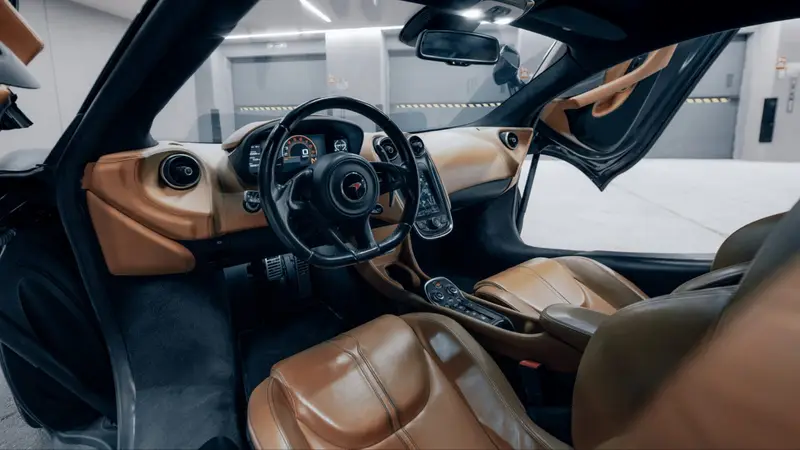
McLaren's character tends to be precise, communicative, and track-focused. The steering is known for telling you exactly what the front tires are doing, the controls feel clean and analytical, and the whole car has an engineered, almost clinical clarity to it. It rewards a driver who wants to feel connected to the road and understand what the machine is doing at every moment. That is very much in keeping with the racing heritage.
Its Italian rivals often lean into a different kind of personality. The character of a Ferrari or a Lamborghini is frequently described as more theatrical and dramatic, with a strong emphasis on emotion, sound, and sheer presence. Neither approach is better or worse. They are simply different philosophies, and part of the fun of this world is experiencing those differences yourself.
When people compare McLaren and Ferrari, the honest answer is that they are chasing different feelings. One is often described as the precise instrument, the other as the passionate showpiece. Both are extraordinary. Which one speaks to you is a matter of temperament, not ranking. The best way to learn where you land is to spend real time in each, ideally on roads that let their characters come through.
What This Means for a First Drive in Miami
All of this history matters because it shapes how a McLaren feels when you finally get behind the wheel, and South Florida happens to be an ideal place to feel it.
A McLaren rewards the right settings. An arrival on Ocean Drive with the doors lifting is the theatrical part, and it is genuinely fun. But the deeper reward comes when you get the car onto open pavement. A cruise up A1A toward Fort Lauderdale, with the water on one side and the road unspooling ahead, is where that famous clarity of steering feel starts to make sense. The car communicates. You feel the road surface, you feel the balance, and you understand what all that racing-derived engineering was actually for.
If you want to experience that firsthand, it helps to work with people who know both the marque and the city. Rushing Rentals has been doing this since 2020, has served more than 750 clients, and keeps a fleet of over 25 vehicles across South Florida from a base in Aventura and North Miami Beach. When it comes to exotic car rental Miami and a proper McLaren rental Miami, the value of a knowledgeable local operator is real: the right car, the right routes, and a process that respects your time. You can read more about the team on the About page.
Experience the Story From the Driver's Seat
If reading about the marque has made you curious to see one in person, the easiest next step is simply to look. Browse the McLaren fleet page to see the specific cars available in the Miami and South Florida area, get a feel for the models, and picture which one fits the drive you have in mind. There is no pressure here. This is about discovery.
When you are ready to ask questions or check availability, the team is easy to reach by phone or WhatsApp at (850) 218-5463, by email at info@rushingrentals.co, or on Instagram at @rushingrentals. Reach out, take a closer look, and let the story come off the page.
Frequently Asked Questions
Is McLaren still a Formula 1 team?
Yes. McLaren continues to compete in Formula 1 today. The team has been part of the sport across many eras, from the 1960s through the modern hybrid age, which makes it one of the most enduring names on the grid. Standings shift from season to season, but the team's presence in the sport is ongoing and central to its identity.
What was the McLaren F1 and why is it famous?
The McLaren F1 was a road car produced in the 1990s, and it is considered one of the most important cars ever built. It is famous for a few reasons: its unusual central driving position, with the driver seated in the middle of the car; its engine bay lined with gold foil for heat management; and its status as the fastest production car of its era, holding a top-speed record that stood for years. It proved a racing team could build a benchmark road car, and it remains a cornerstone of McLaren car history.
Where are McLarens built?
McLaren road cars are designed and built in Woking, England, at the McLaren Technology Centre. That is the same campus that supports the racing operation, which keeps the road-car and race-car sides of the company physically and philosophically close.
Is a McLaren hard to drive?
Not as intimidating as many people assume. McLarens are engineered to feel precise and communicative, meaning the car tends to tell you clearly what it is doing rather than surprising you. That said, it is a genuine high-performance machine and deserves respect, attention, and appropriate roads. If you would rather enjoy the experience without driving yourself, a chauffeur option is available, which is a comfortable way to take in the car on your terms.
Can I rent a McLaren in Miami?
Yes. Rushing Rentals offers McLaren rentals in the Miami and South Florida area. Rates vary depending on the specific model, the length of your rental, and the season, so it is best to think in general ranges rather than a fixed daily figure and to confirm current availability directly. A short single-day rental is possible, as are multi-day and longer arrangements.
What are the basic requirements to rent one?
The essentials are straightforward. The minimum age is 18, you need a valid driver's license, and you need active personal car insurance. If you do not carry your own insurance, you can book the chauffeur service instead. Drivers aged 18 to 21 should be aware that a higher refundable deposit may apply. The team can walk you through the specifics before you book so there are no surprises.
Keep Exploring
If this introduction sparked your curiosity, there is plenty more worth reading. From brand deep-dives to practical buying and rental guides, the blog hub is a good place to keep learning at your own pace. Take your time, explore the marques that interest you, and enjoy getting to know this world before you ever set foot in a driver's seat.