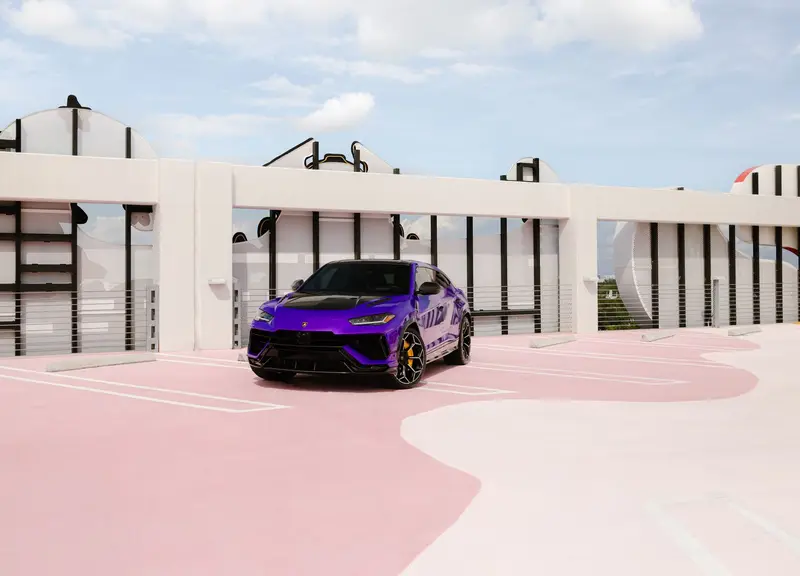
The History of Lamborghini: From Tractors to Supercars

One of the greatest names in automotive history did not begin with a checkered flag or a factory victory lap. It began, as the story goes, with a slight. A wealthy Italian industrialist bought one of the finest cars money could buy, found something he did not like about it, offered his opinion to the man who built it, and was told, in effect, to stick to his own business. What he did next turned a moment of wounded pride into one of the most theatrical brands the world has ever known.
That is the short version, and it is a good one. But the full history of Lamborghini is richer than a single anecdote. It runs from postwar Italian workshops repurposing military scrap, through the birth of the modern supercar, into decades of financial turbulence and reinvention, and out the other side to the bulls prowling Miami's causeways today. This is not a fairy tale, and we are not going to pretend every chapter was triumphant. It is the story of an engineer who trusted his own judgment, a rivalry that pushed two great marques to be better, and a design language so bold it rewrote what people expected a car to be.
Here is how a man who made tractors ended up building some of the wildest machines ever driven.
The Man Before the Bull: Ferruccio's Roots
Before there was a raging bull on any hood, there was Ferruccio Lamborghini, born in 1916 to a farming family in Italy's Emilia-Romagna region. This is the same fertile stretch of northern Italy that gave the world Ferrari, Maserati, and Ducati, a corridor so dense with engineering talent it is sometimes called Motor Valley. Ferruccio grew up more interested in the machines that worked the land than the land itself.
After serving as a mechanic during the Second World War, he returned home with a sharp eye for what could be salvaged and reused. Postwar Italy was short on new equipment and long on discarded military hardware, and Ferruccio saw opportunity in the gap. He began building tractors from repurposed surplus parts, and by 1948 he had founded Lamborghini Trattori. The business grew quickly. Italian farmers needed reliable machinery, and Ferruccio delivered it.
He did not stop there. He expanded into heating systems and later air conditioning, building a small industrial empire across several ventures. By the late 1950s and early 1960s he was, by any measure, a self-made wealthy man. That matters to the history of Lamborghini for a reason beyond biography. The habits that built his fortune, the mechanical mindset, the insistence on doing things properly, the refusal to accept a flaw just because someone with a bigger name signed off on it, are precisely the traits that would define the car company he had not yet imagined building.
Wealth brought him the toys that wealth allows, and Ferruccio developed a taste for fast grand touring cars. He was not a passive owner. He drove them hard, studied them, and formed strong opinions about how they were engineered.
A Businessman With an Enthusiast's Eye
By this point Ferruccio was already a customer of Italy's finest carmakers. He owned several of the era's most celebrated GTs, and he treated them the way he treated everything else, as machines to be understood rather than simply admired. He knew what a good clutch felt like because he built industrial equipment for a living. He knew what refinement should mean.
And when he looked closely at the exotic machinery in his own garage, he did not just see beauty. He saw room for improvement. That single instinct, the conviction that he could do it better, is the seed from which the entire company grew.
The Ferrari Story: Rivalry, Not Rancor
Here is the tale that every Lamborghini fan can recite, told a hundred ways and embellished in most of them. As the story is often recounted, Ferruccio was frustrated by the clutch in his Ferrari. He believed it was not up to the standard the car's price and reputation deserved, and he supposedly noticed the component resembled one used in his own tractors. Confident he could fix it, he arranged a meeting with Enzo Ferrari to share his thoughts.
The exchange, again as the legend has it, did not go well. Enzo is said to have dismissed the tractor maker's opinion, suggesting Ferruccio worry about farm equipment and leave sports cars to the people who understood them. Whether it happened exactly this way, in these words, is impossible to verify. It is part history, part folklore, and it has been polished by decades of retelling. We treat it as the enthusiast's origin myth it has become, not as documented fact.
What is beyond dispute is the outcome. Ferruccio decided to build his own grand tourer, one that would match the performance of the best Italian exotics while offering the refinement and reliability he felt they lacked. He was not out to destroy anyone. He was out to prove a point, and the point was that a self-made engineer's judgment was worth as much as any famous name's.
It is worth being clear here: this rivalry elevated both marques. Ferrari built its legend on the racetrack and continues to produce some of the most desirable cars in the world. If you want to compare the two philosophies side by side, the Ferrari fleet tells its own story of racing heritage translated to the road. The two brands pushed each other, and enthusiasts have been the beneficiaries ever since. Competition, when it is healthy, makes everyone sharper.
Why the Story Endures
The anecdote survives because it is the perfect underdog narrative. A man who made his money in tractors decides he can outdo the aristocracy of Italian sports cars, and then, remarkably, he does. It flatters the idea that expertise and determination can beat prestige and pedigree.
But the honest reading is more generous than the myth. Both companies were led by uncompromising men with total conviction in their own vision. That both visions turned out to be brilliant is the real reason the story matters. This was never a case of one great brand and one pretender. It was two originals, both of them right, both of them enduring.
Proving the Point: The 350 GT and 400 GT
In 1963, Ferruccio founded Automobili Lamborghini in Sant'Agata Bolognese, a town not far from Ferrari's home in Maranello. The proximity was no accident. He built a modern factory, hired ambitious talent, and set out to deliver on the promise behind his decision to leave tractors, at least partly, behind.
His mission was specific: build a grand tourer more refined, more comfortable, and more reliable than the competition, without sacrificing performance. The result was the 350 GT, which entered production in 1964 as the first road-going Lamborghini.
Under the hood sat a V12 engine developed with the help of Giotto Bizzarrini, an engineer whose credentials included work on some of the most storied Italian machinery of the period. Ferruccio wanted a great engine, so he recruited people who had built great engines. The 350 GT was a genuine grand tourer, smooth and quick, engineered with the discipline Ferruccio demanded. It was not a novelty or a vanity project. It was a serious car that established the fledgling company as a credible manufacturer almost immediately.
The 400 GT followed, expanding on the formula with a larger engine and a proper 2+2 seating configuration that made it more usable for buyers who wanted occasional rear seats. Sales were modest by mass-market standards, but that was never the point. These cars proved that a tractor maker could build a world-class GT, and they gave Lamborghini the foundation and the confidence to attempt something far more radical.
The Miura and the Birth of the Supercar
If the 350 GT proved Lamborghini belonged in the conversation, the Miura proved it could lead it.
Introduced in 1966, the Lamborghini Miura did something almost no road car had done before. It placed its V12 engine in the middle of the car, mounted transversely, or sideways, behind the driver rather than in front. This was a layout borrowed from the world of racing, where it was already understood to be superior, and putting it into a production road car was a genuinely daring move.
For a reader who is new to this, here is why the mid-engine layout matters so much. When you place the heaviest component, the engine, near the center of the car rather than over the front wheels, you balance the weight more evenly between front and rear. That balance transforms how the car behaves. It turns more crisply, feels more planted through corners, and puts its power down more effectively. The mid-engine configuration became the template for high-performance road cars, and it is still the layout most exotic manufacturers reach for today. If you have ever wondered why so many sports cars share that same low, cab-forward silhouette, the Miura is a large part of the answer.
The engineering was the work of a group of young, hungry talents at Lamborghini who pushed the concept forward, reportedly with more enthusiasm than official sanction at first. Ferruccio initially saw the company as a builder of refined GTs, not extreme mid-engine exotics. But when the chassis was shown and the response was electric, the project earned its place.
Then Bertone wrapped it in one of the most beautiful bodies ever drawn. The Miura's low, sculpted shape, with its distinctive slatted engine cover and eyelash headlight surrounds, stopped people in their tracks. It looked like nothing else on the road. Many enthusiasts and historians consider it arguably the first modern supercar, the machine that established the category as we understand it: mid-engine, extreme performance, and styling that was as much art as engineering.
A Design That Changed Expectations
The Miura's significance goes beyond its mechanical layout. It made the performance glamorous. Before the Miura, a fast car could be beautiful, but the Miura fused speed and beauty so completely that one seemed impossible without the other.
That fusion set the tone for everything Lamborghini would become. The company would not merely build quick cars. It would build cars that made an entrance, that turned performance into spectacle. The Miura was the moment that promise first came true.
The Countach and the Wedge Era
If the Miura was beautiful, the Countach was shocking, and that was entirely the point.
Arriving in production in 1974 and evolving through the following decade and a half, the Countach abandoned the Miura's flowing curves for something radically different: a sharp, angular wedge that looked as though it had been carved from a single block. It was aggressive, futuristic, and completely unlike anything else. Where the Miura seduced, the Countach confronted.
It also introduced the feature that would become Lamborghini's most recognizable signature: scissor doors that swung upward rather than out. There were practical reasons for the design, related to the car's width, but the visual effect was pure theater. Those doors would appear on flagship Lamborghinis for decades to come, an instantly identifiable calling card.
For a generation of enthusiasts, the Countach was the supercar. It hung on bedroom walls throughout the 1970s and 1980s, the definitive poster car, the object of aspiration for kids who had never seen one in person and might never. It cemented Lamborghini's identity as the maker of the most dramatic, most extreme, most visually uncompromising cars on earth. Among the most iconic Lamborghini models ever built, the Countach is the one that fixed the brand's visual language in the public imagination.
Function Meets Spectacle
It would be dishonest to pretend the Countach was without compromise. The dramatic wedge shape and the low, wide body came at a cost. Rearward visibility was famously poor, to the point that drivers sometimes opened the door and sat on the sill to reverse. It was not a comfortable everyday companion, and it demanded commitment from anyone who drove it.
But that was part of the bargain. The aggressive aerodynamics and the sheer physical presence of the car were the reward for its impracticality. The Countach was never meant to be sensible. It was meant to be unforgettable, and it succeeded so thoroughly that its influence on Lamborghini's design language has never faded.
Turbulence, Owners, and Reinvention
The romance of the cars can make it easy to forget how close Lamborghini came to disappearing more than once. The truth is that for much of its history, the company was financially fragile.
The 1973 oil crisis hit exotic carmakers hard, and Lamborghini was not spared. Compounding the pressure, a major tractor contract fell through, damaging Ferruccio's other core business. Facing mounting difficulties, Ferruccio began selling off his stake in the car company in the mid-1970s, and by 1974 he had stepped away entirely from the enterprise that carried his name.
What followed were years of instability. The company passed through a series of owners, including Swiss investors who kept it running through a difficult stretch, and later a period under Chrysler ownership in the late 1980s and early 1990s. Ownership then shifted again, at one point to Indonesian interests, before the company finally found lasting stability when it was acquired by the Audi division of the Volkswagen Group in 1998.
Through all of this turbulence, the cars kept coming, and two in particular kept the flame alive. The Diablo, launched in 1990, carried the flagship torch through the uncertain years, a proper successor to the Countach with even more power and presence. It was followed by the Murcielago, introduced in the early 2000s as the first all-new flagship developed under Audi's stewardship. These were the bridge cars, the machines that connected the wild early era to the disciplined modern one.
It would be melodramatic to frame these decades as a near-death saga, and unfair to overstate the chaos. Plenty of great companies pass through difficult ownership periods. What is fair to say is that the arrival of the Audi era brought something Lamborghini had rarely enjoyed: stability, deep engineering resources, and manufacturing discipline. That foundation made everything that came next possible.
The Modern Fleet: Precision Meets Drama
The modern Lamborghini is a different kind of company from the one Ferruccio founded, and mostly for the better.
The turning point was the Gallardo, launched in 2003. It was smaller, more attainable, and far more usable than the flagship V12 cars, and it sold in numbers Lamborghini had never seen before. The Gallardo transformed the company from a boutique builder of a few hundred cars a year into a genuine volume manufacturer of exotics. It is difficult to overstate how important that shift was to the company's survival and growth.
The Gallardo's successor, the Huracan, refined the formula further, pairing a spectacular V10 with everyday drivability that earlier Lamborghinis could only dream of. Above it sat the Aventador, the V12 flagship that carried the scissor-door tradition forward with theatrical styling and immense performance. And then came the car that changed everything again.
The Urus, a super-SUV introduced in 2018, broadened Lamborghini's appeal to an entirely new audience. Suddenly the brand offered a car with room for a family, luggage, and daily errands, wrapped in a genuine Lamborghini attitude and backed by serious performance. It became the company's best-selling model and pulled in buyers who would never have considered a low-slung two-seater. You can see the full spread of the brand's current character across the Lamborghini fleet, from the road-hugging supercars to the high-riding Urus.
What Audi's involvement brought to all of this was reliability and usability without erasing the showmanship. The modern Lamborghini starts every time, behaves predictably, and can be driven daily, yet it still sounds outrageous, looks outrageous, and makes every arrival an event. That balance, precision meeting drama, defines the brand today. These are among the most iconic Lamborghini models the company has ever produced, and they are built to a standard the early cars, for all their charm, never quite reached.
The Urus and a Wider Audience
The Urus deserves special mention because of who it brought into the fold. For decades a Lamborghini was a statement car, thrilling but impractical, something you drove on weekends or special occasions. The Urus made the brand a genuine daily-usable proposition.
That opened the door to buyers who wanted the badge and the presence but needed a car that fit real life, including a growing number of drivers who might never have looked at the brand before. Crucially, Lamborghini managed this expansion without softening its edge. The Urus is unmistakably a Lamborghini, loud and aggressive and dramatic, just one you can actually live with. If the shape appeals to you, it sits comfortably alongside the rest of the exotic SUV segment while still standing apart from it.
The Design DNA: Bulls, Badges, and Theater
Look at any Lamborghini and you will find a raging bull on the badge. The symbol comes from Ferruccio himself, who was born under the zodiac sign of Taurus and developed a deep fascination with bullfighting. He admired the power, the drama, and the spectacle of the sport, and he built those qualities into the identity of his company.
The bull runs through the naming, too. The Miura was named after a famous line of fighting bulls. The Islero, Murcielago, Aventador, and Huracan all take their names from celebrated bulls or bullfighting terms. It is a naming tradition that ties every model back to Ferruccio's original inspiration, a thread of continuity connecting the earliest cars to the newest.
That sense of theater is not just marketing. It is baked into the driving experience. The howl of the engine, the upward sweep of the doors, the way people stop and stare, all of it is part of the design intent. A Lamborghini is engineered to be felt and seen, not just driven.
Which is exactly why the brand feels so at home in South Florida. A Lamborghini rental in Miami is not really about transportation. It is about the sight of an Aventador rolling down Ocean Drive at dusk, the sound of a Huracan echoing off the buildings in Brickell, the drama of scissor doors rising in a valet line. The city and the car share a sensibility: bold, expressive, unapologetic. The theater Ferruccio built into his machines finds a natural stage on the causeways and boulevards of Miami.
Experiencing the Legend in Miami
For all the history and engineering, the truth of Lamborghini has always been simpler than any of it. The brand was built on aspiration made real, on the idea that the extraordinary should be experienced rather than just admired from a distance. And the honest way to understand the story we have just told is from behind the wheel, hearing that engine and feeling that presence yourself.
That is where we come in. Rushing Rentals has been part of the South Florida exotic scene since 2020, and over that time we have put more than 750 happy clients into cars they had only dreamed about. We keep a fleet of 25-plus vehicles and operate across multiple locations anchored in Aventura and North Miami Beach, which means the machines are close, the process is straightforward, and the people handling your reservation actually know these cars.
A few practical notes worth knowing before you book. The minimum age to rent is 18, and you will need a valid driver's license and active personal car insurance. If you do not carry your own policy, our chauffeur service is a simple alternative that lets you enjoy the car without the paperwork. Drivers between 18 and 21 should expect a higher refundable deposit, which is standard given the value of these machines. None of it is complicated, and we are happy to walk you through it.
If the story of the bull has you curious, the best next step is to see one in person. Explore the Lamborghini fleet and picture which one belongs on your next drive down the coast. When you are ready to ask questions or check availability, reach us by phone or WhatsApp at (850) 218-5463, email us at info@rushingrentals.co, or send a message on Instagram at @rushingrentals. No pressure and no script, just a straightforward conversation about experiencing the legend for yourself.
Frequently Asked Questions
Why did Ferruccio Lamborghini start building cars?
Ferruccio Lamborghini was a successful industrialist and an enthusiastic owner of fast grand touring cars, and he believed he could build one better than what was available. He wanted a more refined, more reliable, and more comfortable GT without sacrificing performance. The widely told anecdote about a disagreement with Enzo Ferrari over a clutch is part history and part folklore, but the underlying motivation is well documented: Ferruccio trusted his own engineering judgment and set out to prove it.
What was the first Lamborghini car?
The first production Lamborghini was the 350 GT, which entered production in 1964. It was a V12-powered grand tourer developed with serious engineering talent, and it established the young company as a credible builder of world-class GTs rather than a novelty. It was followed by the 400 GT, which added a larger engine and 2+2 seating.
Why is the Lamborghini Miura so important?
The Lamborghini Miura, introduced in 1966, placed a V12 engine in the middle of the car rather than the front. That mid-engine layout dramatically improved weight distribution and handling, and it became the template for high-performance road cars ever since. Combined with its show-stopping Bertone design, the Miura is widely considered arguably the first modern supercar and the car that defined the category.
What are the most iconic Lamborghini models?
Spanning the eras, the standouts include the Miura, the Countach, the Diablo, the Murcielago, the Gallardo, the Huracan, the Aventador, and the Urus. Each represented a milestone, from defining the supercar to introducing scissor doors to expanding the brand into a usable super-SUV. You can see several of these in person through the Lamborghini fleet.
Who owns Lamborghini today?
Lamborghini has been part of the Audi division of the Volkswagen Group since 1998. After decades of financial instability and several ownership changes, the Audi era brought lasting stability, deep engineering resources, and manufacturing discipline, which enabled the reliability and usability of the modern lineup.
Can I drive a Lamborghini in Miami?
Yes. A Lamborghini rental in Miami is one of the most popular ways to experience the brand, and it suits the city perfectly. You can browse the available models on the Lamborghini fleet page and reach out with any questions. It is a low-pressure way to feel the history we have described here for yourself.
Learn the History Before Renting One
From a workshop building tractors out of military scrap to a global icon of speed and design, the history of Lamborghini is proof that a moment of frustration, handled with enough conviction, can become a legend. A grudge, as the story goes, turned into one of the most recognizable brands on earth. If you enjoyed this and want more stories, guides, and Miami driving inspiration, browse the blog.