What Is a Grand Tourer Car? The GT Class of Luxury Vehicles Explained

Picture the drive south out of Miami on a bright Saturday morning. The city thins out behind you, the causeways open up, and eventually you are on the long, low ribbon of US-1 heading toward Key Largo, water on both sides and the horizon stretched wide. Somewhere around Card Sound the air changes and the trip itself becomes the point. In moments like that, the car underneath you matters. So if you are wondering what a grand tourer car actually is, you have already found the perfect stage to answer the question. A grand tourer, or GT, is the machine built for exactly this kind of journey: fast, refined, and comfortable enough to make distance feel like a pleasure rather than a project.
This is a primer, not a pitch. The goal is to explain the GT class clearly, walk through what separates it from supercars and luxury sedans, and show why it fits South Florida driving so well. We know these cars because we live with them day to day here in Aventura and North Miami Beach, so expect real models and real routes rather than vague generalities. By the end you should understand the category well enough to know whether a grand tourer is the right car for your next trip.
What Is a Grand Tourer Car? The Short Answer
A grand tourer is a high-performance luxury car engineered to cover long distances at speed while keeping the driver and passenger comfortable. That is the whole idea in one sentence. The name comes from the Italian phrase gran turismo, which translates roughly to "grand touring." So when people ask about the GT car's meaning, the language itself gives it away: this is a car designed for touring, for the grand road trip, for eating up miles in style.
A few classic hallmarks tend to show up in cars we call grand tourers. Most use a front-engine or mid-front-engine layout, which helps with weight balance and leaves room for a proper cabin. Seating is usually a strict two-seat arrangement or a 2+2 setup, meaning two full seats up front and two smaller ones in the back. GTs typically carry a larger fuel tank and a more usable trunk than a pure supercar, because range and luggage space are part of the mission.
It is worth being honest here: the definition has soft edges. Enthusiasts argue about which cars truly qualify, and the boundaries shift over time as manufacturers reinterpret the idea. That debate is part of what makes the category interesting. But the core intent stays constant. A grand tourer is about the journey first.
The Origin of the Grand Tourer
From European Road Trips to a Design Philosophy
The grand tourer traces back to a very specific way of traveling. In mid-century Europe, wealthy drivers wanted cars that could carry them across countries and continents comfortably and quickly. The idea was not to set a lap record at a circuit. It was to leave Milan in the morning, cross the Alps, and arrive at the French Riviera by evening without stepping out exhausted. That practical ambition, driving far and fast in comfort, is what gave the class its name and its purpose.
That founding purpose shaped the engineering priorities that still define the category. If your car needs to run for hours on open road, you build it with a supple suspension, a quiet cabin, seats that support you over long stints, and enough space to carry luggage for a proper trip. You give it a big, muscular engine that can cruise effortlessly rather than one tuned solely for peak track numbers. Those choices were not compromises. They were the entire point. Decades later, the modern grand tourer still carries that DNA, even as the technology around it has changed completely.
The Comfort-Performance Blend: What Makes a GT a GT
The defining trait of a grand tourer is a deliberate trade-off. A GT gives up a fraction of outright track focus in exchange for usable, everyday refinement. This is not a case of one approach being better than another. It is a matter of purpose. A car built to lap a circuit as fast as possible and a car built to cross Florida in a single relaxed day are answering two different questions. The grand tourer answers the second one, and it does so on purpose.
That blend comes from a handful of practical ingredients working together. Understanding them makes it easier to spot a true grand tourer when you see one.
Ride Quality and Cabin Refinement
The first ingredient is comfort you can feel over hours, not seconds. Grand tourers tend to run softer, more compliant suspension tuning than track-focused cars. That means the ride absorbs road imperfections instead of transmitting every ridge straight into your spine. Sound insulation is another priority, so highway noise stays subdued and conversation stays easy. The seats are designed for long-haul support rather than aggressive bolstering that pins you in place for a hot lap. Spend three hours in a well-sorted GT and you step out relaxed. That is the standard the category is chasing.
Range, Storage, and Real-World Usability
The second ingredient is practicality, which sounds unglamorous until you are on hour four of a drive. Grand tourers carry larger fuel tanks so you stop less often, and they offer more luggage space than a stripped-back exotic. Interiors are laid out for real use: cupholders, storage, and climate control that actually keeps up with a South Florida afternoon. Contrast this with a pure mid-engine supercar, which can be a thrill for a spirited hour and then grow punishing over distance, with a tiny trunk, a firm ride, and a cabin that puts sensation ahead of serenity. The GT is built to stay pleasant when the miles pile up.
Performance Without Compromise
None of this means a grand tourer is slow. That is the misunderstanding worth clearing up. GTs still deliver serious power and genuine pace. The difference is in how that performance is delivered. Instead of a razor-edged, all-or-nothing character, a grand tourer tends to offer smooth, muscular thrust that is easy to access and easy to modulate. You get the acceleration and the top-end capability, just wrapped in a package that stays composed and usable. Comfort and speed are not opposites in this class. They are engineered to coexist.
Grand Tourer vs. Supercar vs. Luxury Sedan
To place the grand tourer accurately, it helps to compare it to its neighbors. Think of this as a comparison of jobs, not a ranking. Each of these categories does something well, and the right choice depends entirely on what you want out of the drive.
Grand Tourer vs. Supercar
The grand tourer vs supercar question comes up constantly, and the honest answer is that they pursue different goals. A supercar prioritizes outright performance, low weight, and track-focused dynamics. Everything is optimized for cornering grip, acceleration, and lap times, sometimes at the expense of comfort and practicality. A grand tourer prioritizes distance, comfort, and daily livability while still delivering strong performance. Both are thrilling. They simply thrill in different ways. A supercar rewards intensity and precision. A grand tourer rewards the long, effortless run. Neither is superior. They are built for different missions.
Grand Tourer vs. Luxury Sedan
The luxury sedan sits on the other side of the grand tourer. A luxury sedan leads with quiet comfort, space, and often room for four or five passengers in real refinement. A grand tourer takes that comfort and adds sharper performance and a more driver-focused character, usually in a lower, sleeker, two-door or 2+2 body. At the very top of the market, the overlap is real. Some flagship luxury cars deliver so much performance that they brush against grand-touring territory, and some grand tourers are as plush inside as any sedan. The distinction is one of emphasis, not a hard wall.
Where the Lines Blur
It would be dishonest to pretend these categories have crisp borders. They do not. Many cars sit comfortably between definitions, and reasonable people disagree about where a given model belongs. A high-performance luxury coupe might read as a grand tourer to one enthusiast and a sports car to another. That ambiguity is not a problem. It is a sign of how much the industry blends ideas today. If you enjoy exploring the overlap, browsing by category can help; our luxury car type and sports car type pages group the fleet in ways that make the differences easier to feel out for yourself.
Real Examples: Grand Tourers and GT-Adjacent Cars
Definitions become clearer with real cars in front of you. What follows is a set of illustrative examples across the grand-touring spectrum rather than a definitive ranking. Some of these are textbook GTs, some sit at the edges of the class, and a couple are best described as GT-adjacent. Using cars from our own fleet keeps this concrete, and it shows how varied the category can be in practice.
The Front-Engine V12 Archetype: Ferrari F12 Berlinetta
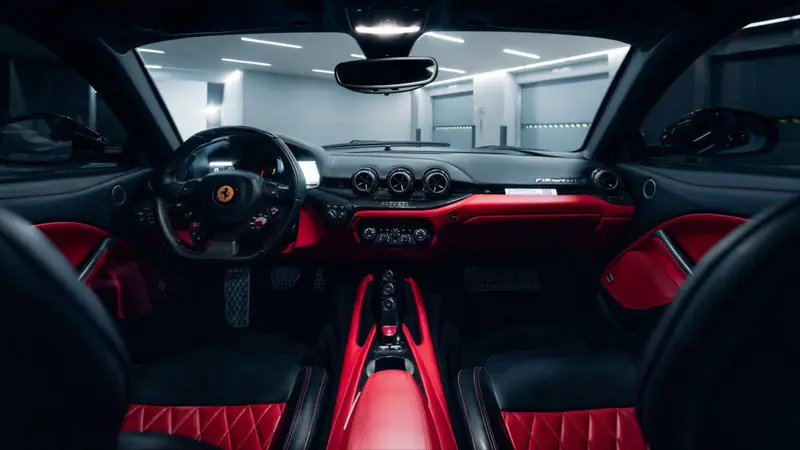
If you want a textbook grand tourer, start with the Ferrari F12 Berlinetta. It checks every box the classic definition asks for. A big, naturally aspirated V12 sits up front, driving the rear wheels. There are two seats, generous grand-touring proportions, and a long hood that signals exactly what it is built for. The performance is enormous, but the way it arrives is part of the appeal: dramatic, muscular, and delivered with a sense of occasion rather than raw aggression. This is a car that could genuinely carry you across a continent, and it represents the front-engine V12 tradition that shaped the whole class. Among Ferraris, it leans harder toward grand touring than the brand's most track-focused mid-engine cars.
The Crossover Case: Audi R8
The Audi R8 Coupe V10 Plus is a fascinating case because it sits between categories. On paper it is a mid-engine exotic with a screaming V10, which places it firmly in supercar company. Yet the R8 has always been notably usable and refined for everyday driving, with a friendly cabin, good visibility, and a ride that does not beat you up around town. That combination gives it a grand-touring flavor even though most people would classify it as a supercar first. We would not overclaim it as a pure GT, but it is a great example of how a genuinely exotic car can carry real touring manners. If you want supercar drama with more daily comfort than the label usually implies, the R8 makes the argument.
Grand-Touring Performance: BMW M8 Competition
The BMW M8 Competition is a modern interpretation of the grand tourer done well. It pairs serious performance with long-distance comfort and a 2+2 layout that adds real-world practicality. The power is abundant and the chassis is capable, but the car never forgets that you might want to drive it for hours. The cabin is quiet and well finished, the seats support you over distance, and there is enough space to make a weekend trip feasible. This is a grand-touring performance in the contemporary luxury-coupe idiom, and it shows how the category has evolved from its mid-century roots into something with modern technology and everyday manners.
The Luxury Touring Interpretation: Mercedes S580 and Rolls Royce
At the comfort-forward end of grand touring, the emphasis shifts even further toward serenity. The Mercedes-Benz S580 is a flagship built to make distance disappear. It is technically a luxury sedan, but the touring spirit is unmistakable: a hushed, spacious cabin, effortless acceleration, and the kind of composed ride that turns a long highway stint into something close to relaxing. A Rolls Royce takes the comfort-forward interpretation to its peak, with a cabin engineered around isolation and calm. These cars remind us that grand touring is as much about how you feel after the journey as how fast you covered it.
An Accessible GT-Adjacent Choice: Corvette C8
Finally, the Corvette C8 3LT offers an approachable entry point to the touring experience. We would call it GT-adjacent rather than a classic grand tourer, since it leans sports-car in character with its mid-engine layout. But it earns a mention because it delivers comfortable-enough performance with genuinely usable storage, including a front trunk and a rear compartment that together make real trips possible. The ride is livable, the cabin is pleasant, and the pace is more than enough for anything Florida's roads will throw at you. For someone new to this world who wants a taste of grand touring without the most exotic commitment, the C8 is a smart, accessible place to begin.
Why the Grand Tourer Fits South Florida
Categories matter most when they meet real roads, and this is where the grand tourer earns its keep. South Florida is, in many ways, an ideal GT country. The distances are meaningful, the scenery rewards a slower pace, and the climate demands a comfortable, well-sealed cabin. If you are considering a luxury car rental Miami trip and want the car to enhance the drive rather than fight it, understanding this fit is worth your time.
The Run to the Keys
The long, open stretch down to Key Largo and beyond is the classic case for a grand tourer. Once you clear the mainland, you are looking at hours of driving with water on both sides and the occasional stop for stone crab or a swim. That kind of journey rewards comfort and range. A hardcore supercar can wear you out on a run like this, with a firm ride and constant road noise that turn a beautiful drive into a workout. A grand tourer stays a pleasure the whole way down, and just as pleasant on the way back. The trip becomes the highlight, exactly as the class intended.
Coastal Cruising on A1A
Not every great South Florida drive is about distance. A1A along the coast is about atmosphere: slower speeds, ocean views, palm-lined stretches, and the easy rhythm of cruising. On roads like this, lap times are irrelevant. What matters is refinement, a settled ride, and a cabin you actually want to spend time in. A grand tourer shines here because it is built to be enjoyable at any pace. You can roll the top down or open the windows, take it easy, and let the car do what it does best, which is make the whole experience feel effortless and elevated.
Weekend Touring: Miami to Naples and Beyond
Then there are the multi-day trips that cross the state. A weekend run from Miami over to Naples and the Gulf coast, or up toward Palm Beach and beyond, is where a grand tourer's strengths become obvious. You need luggage space for real bags. You want seating that stays comfortable across a couple of full days. You appreciate a settled, quiet ride when you are covering ground and dealing with heat, traffic on the way out of the city, and long open stretches once you are clear of it. Every one of those factors rewards a GT. This is the trip the category was invented for, translated to Florida geography.
How to Choose the Right Car for Your Trip
The most useful advice we can give is simple: match the car to the journey, not the badge. A great exotic car rental Miami experience starts with being honest about what you actually plan to do. The most exciting car on paper is not always the right one for your specific trip, and the right one depends on where you are going and for how long.
Short City Flex vs. Multi-Day Touring
For a quick night out in South Beach, a photo shoot around the Design District, or a single evening making an entrance at a dinner or event, a sharper sports car or a bold statement piece may be exactly the play. In that context you are prioritizing presence and drama over long-haul comfort, and a more aggressive car delivers. For distance and multiple days, the calculus flips. When you are planning a run to the Keys or a weekend across the state, lean toward true grand-touring comfort. Both approaches are valid. The trick is knowing which trip you are actually taking before you pick the car.
Prefer to Ride Than Drive? Consider a Chauffeur
There is also the option of not driving at all. For long stretches, airport runs, or anyone who would simply rather relax and enjoy the ride, chauffeur service is available. This is a genuine convenience rather than something to upsell you into. If you want to arrive at a meeting composed, or spend a scenic drive taking in the view instead of watching traffic, a chauffeur makes that possible. It is also the answer for anyone who does not carry their own personal car insurance, since booking a chauffeur removes the requirement to drive on your own policy. For plenty of trips, being driven is the more luxurious choice anyway.
Practical Rental Basics in Miami and South Florida
If you decide a grand tourer suits your trip, the process itself is straightforward, and knowing the rules up front makes it smoother. Here are the essentials, stated plainly.
- Minimum age is 18. You do not have to wait until 25 to get behind the wheel of something special.
- A valid driver's license and active personal car insurance are required to drive the car yourself. If you do not have your own insurance, you can book chauffeur service instead and still enjoy the car.
- A higher refundable security deposit may apply for drivers ages 18 to 21. The deposit is refundable, and the exact figure depends on the car and the reservation.
On cost, it is best to think in general terms rather than fixed numbers. Daily and multi-day rates vary by model and by season, since demand in South Florida shifts through the year. For longer stays, monthly rental programs exist and can change the math meaningfully compared to booking day by day. The most reliable way to understand pricing for the specific car and dates you want is to reach out directly, since rates move with availability and time of year.
The Bottom Line on Grand Tourers
Strip away the debate over exact boundaries and the grand tourer comes down to one clear idea: it is the car built for the journey. It blends real performance with genuine comfort, delivering speed you can feel and refinement you can live with over hours behind the wheel. That balance is not a compromise. It is the entire purpose of the class, carried forward from mid-century European road trips to the modern machines in our fleet today. On South Florida's open roads, from the run down to the Keys to a weekend across the state, the grand tourer earns its keep more convincingly than almost anywhere else.
That is the perspective we bring to every conversation. Rushing Rentals was founded in 2020, and over six-plus years we have served more than 750 happy clients with a fleet of 25-plus vehicles spanning Audi, BMW, Ferrari, Lamborghini, McLaren, Mercedes-Benz, Porsche, and Rolls Royce, operating out of locations in Aventura and North Miami Beach. We know these cars and we know these roads, which is why we would rather help you match the right car to the right trip than push you toward the flashiest name.
Explore the Fleet and Plan Your Drive
If reading this has you picturing the drive, that is the right instinct. The best next step is simply to browse and imagine the trip. Take a look at the full fleet on our homepage, then narrow it down by category with the luxury car type and sports car type pages to see which cars fit the journey you have in mind.
When you want to talk it through, we are easy to reach. Call or WhatsApp us at (850) 218-5463, email info@rushingrentals.co, or follow along on Instagram @rushingrentals. If you want to keep reading first, our blog covers related model comparisons and scenic-drive ideas to help you plan.
Frequently Asked Questions
What is a GT car?
A GT car is a grand tourer: a luxury performance car designed for long-distance, high-speed driving in comfort. The GT car meaning comes from the Italian gran turismo, or grand touring. These cars typically feature 2 or 2+2 seating, a comfortable and well-insulated cabin, usable storage, and enough range to make real trips practical, all paired with serious performance.
Is a grand tourer the same as a supercar?
No, though they overlap. The two pursue different goals, which is the heart of the grand tourer vs supercar distinction. Supercars chase outright performance, low weight, and track-focused dynamics. Grand tourers balance strong performance with touring comfort and everyday usability. Both are exciting. They simply prioritize different things, and the right one depends on whether you value intensity or the long, effortless drive.
Are grand tourers good for daily driving?
Generally yes, and more so than pure supercars. Their softer suspension tuning, quieter cabins, and greater practicality make them easier to live with day to day. That said, it still depends on the specific model. Some grand tourers lean more toward performance and are firmer, while others prioritize comfort and feel almost sedan-like. If daily usability matters to you, it is worth checking the character of the particular car.
What does 2+2 mean in a GT?
A 2+2 layout means two proper front seats plus two smaller rear seats. The rear seats are best suited for shorter trips, extra luggage, or occasional passengers rather than full-size adults on a long drive. It is a practical touch that gives a grand tourer more flexibility than a strict two-seater, without turning it into a full four-seat car.
Can I rent a grand tourer in Miami?
Yes. Rushing Rentals offers grand tourers and GT-adjacent models for daily, multi-day, and monthly rental across South Florida. To drive one yourself you must be at least 18, hold a valid driver's license, and carry active personal car insurance. If you would rather be driven, or you do not have your own policy, you can book chauffeur service instead.
Which grand tourer is best for a trip to the Keys?
The best choice is a comfort-forward, well-equipped grand tourer with good range and enough space for your bags, since the run to the Keys rewards refinement over track focus. Rather than crown a single winner, we would point you to the fleet to compare options, because the right car depends on how many people are traveling, how much you are packing, and the kind of driving experience you are after.