How Do Supercars Work? The Engineering Behind Extreme Speed
The first thing that hits you is the sound. Then, a fraction of a second later, the shove. You press the throttle and the car seems to gather the road up beneath it, pinning your shoulders to the seat while the exhaust climbs from a hard bark to something closer to a shriek. Corners feel different too. The car sits down and turns in like it knows exactly where you want to go before you do. It feels less like driving and more like the machine and the pavement have entered into a private agreement.
So how do supercars work? What is actually happening under all that drama? That is what this guide is for. We are going to decode the engineering behind extreme performance in plain English, with no engineering degree required and no equations to memorize. Engines, aerodynamics, weight, gearboxes, brakes, tires, and the electronics that tie it all together. By the end you will understand what you are feeling the next time one of these cars pushes you back into the seat.
We explain this from real seat time, not spec sheets. Since 2020, Rushing Rentals has put more than 750 clients behind the wheel of exactly these machines across South Florida, from Aventura to Fort Lauderdale to the causeways connecting the mainland to the beach. That experience shapes how we talk about these cars. You can read more about who we are on our about page, but for now, let us get into the mechanics of magic.
What Actually Makes a Supercar a Supercar
Here is the first misconception worth clearing up. A supercar is not simply a car with a big horsepower figure. Plenty of large sedans and heavy SUVs make impressive power on paper without ever feeling like a supercar. What defines the category is integration. A supercar is a system in which the engine, the weight, the aerodynamics, the tires, and the electronics are all designed to work together toward the same goal. Change one and you have to rethink the rest.
That integration is why two cars with similar horsepower can feel worlds apart. One might feel fast in a straight line but clumsy in a corner. The other feels alive everywhere, responsive to the smallest inputs, planted and precise. The difference is engineering philosophy, not just the number under the hood.
Power-to-Weight Is the Number That Matters
If you take only one idea from this guide, make it this one. Power on its own tells you very little. Power relative to weight tells you almost everything.
Picture two equally strong sprinters. One runs with nothing on his back. The other runs carrying a loaded backpack. The one with the extra weight loses every time. That is power-to-weight in a nutshell. A lighter car with the same engine accelerates harder, brakes shorter, and changes direction faster than a heavier one.
This is why raw horsepower can be misleading. A powerful luxury sedan might match a supercar's headline figure while weighing far more, which means all that power has more mass to move. The supercar, built lighter and lower, does more with less. This is not a knock on fast sedans. They are engineered for a different job entirely, and they do it beautifully: quiet cabins, long-distance comfort, room for passengers, and the ability to serve as a genuine daily driver. A supercar makes different trade-offs, giving up some of that comfort in exchange for a purity of response that a heavier car simply cannot replicate.
The Engine: The Heart of the Experience
If power-to-weight is the physics, the engine is the personality. Two supercars can produce nearly identical performance and still feel like completely different animals because of how their engines deliver that performance and, just as importantly, how they sound doing it. The engine is the character of the car. There are three broad philosophies you will encounter, and each has passionate defenders.
Naturally Aspirated vs. Turbocharged vs. Hybrid
A naturally aspirated engine breathes air at normal atmospheric pressure. Nothing is forcing extra air in. The reward for this simplicity is a wonderfully linear power delivery and, in the best examples, a soaring redline. Push the throttle and the power builds in perfect proportion to your foot, climbing and climbing as the revs rise toward a screaming top end. The trade-off is that these engines need revs to make their biggest numbers. You have to wind them out to feel the full effect, which is part of the drama and, for many enthusiasts, part of the joy.
A turbocharged engine uses the exhaust gases to spin a turbine that jams extra air into the engine. More air means more fuel can be burned, which means more power and, crucially, more torque lower in the rev range. Put your foot down at almost any speed and a turbocharged supercar surges forward immediately, without waiting for high revs. Turbos also tend to be more efficient. The character is different, and some purists find it slightly less raw than the building crescendo of a naturally aspirated engine. Neither view is wrong. Both approaches are marvels, and modern turbo engines have closed much of the old gap in throttle response.
The hybrid supercar is the newest chapter. It pairs a combustion engine with electric motors that deliver torque instantly, filling in any gap while the engine gets on song. Electric power arrives the moment you ask for it, so hybrids can feel astonishingly immediate. This is increasingly the direction the industry is heading, as manufacturers chase both performance and efficiency, and the results at the top end are staggering.
Why Cylinder Count and Redline Matter
More cylinders generally means a smoother, more complex sound and, often, the ability to rev higher. Redline is the maximum engine speed, and a higher redline usually means a more thrilling top end. These are not abstract numbers. You feel them and, most memorably, you hear them.
Consider the V10. The Audi R8 Coupe V10 Plus is a naturally aspirated benchmark. There is no turbo muffling the noise, no electric motor smoothing the delivery. Just ten cylinders breathing freely and spinning toward a redline that produces a metallic top-end wail unlike almost anything else on the road. Wind it out and the sound reaches a pitch that raises the hair on your arms.
Now step up to a V12. The Ferrari F12 Berlinetta carries a big-displacement front-mounted V12, and the experience is one of enormous reach and drama. Twelve cylinders give it a depth and richness of sound, along with a relentless, seemingly endless supply of power as the revs climb. It is theatrical in the best possible way.
Then there is the twin-turbo V8 philosophy, exemplified by McLaren. McLaren's engineering-forward approach leans into torque-rich, immediate delivery, with a focus on efficiency and lightness. It is a different flavor from Ferrari's naturally aspirated heritage, and comparing the two is a bit like comparing two brilliant chefs who cook in different styles. Both are worthy of admiration. Which you prefer comes down to what moves you: the building scream of high revs or the instant, muscular surge of boost.
Engine Placement: Mid-Engine vs. Front-Engine
Where the engine sits changes how the whole car behaves. Place the engine behind the driver but ahead of the rear axle, and you get what is called a mid-engine layout. This concentrates the car's mass near its center, which improves balance and makes the car eager to change direction. The nose feels lighter and turns in more crisply. It is one of the reasons so many supercars feel almost telepathic through a corner.
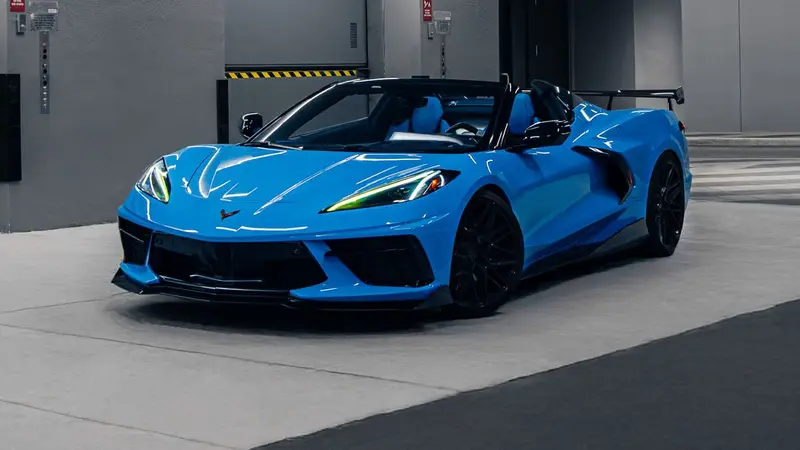
The mid-engine idea used to be reserved for the most exotic machinery, but that has changed. The Corvette C8 3lt moved the engine behind the driver for the first time in the model's long history, a dramatic shift from the front-engine C7 that came before it. The result is a fundamentally different feel, more planted and more balanced, and a genuinely accessible entry into the mid-engine experience.
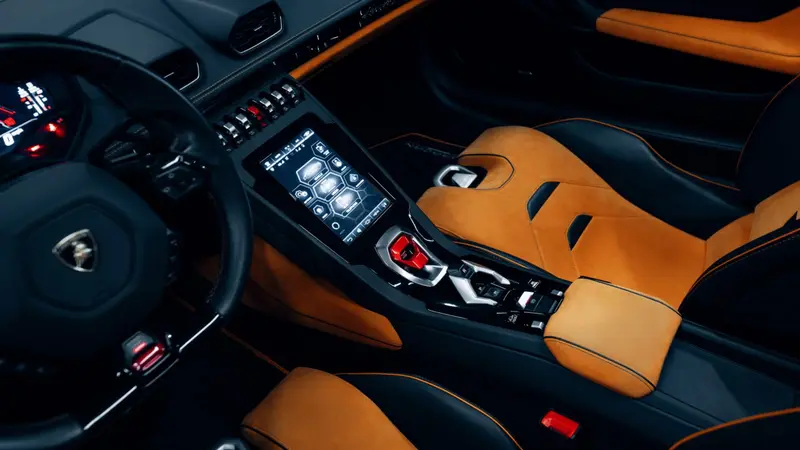
For the classic expression of the layout, look to Lamborghini, which has built its identity around the mid-engine formula for decades. The dramatic proportions, the engine sitting just behind your head, the sound pouring in from directly over your shoulder: this is the mid-engine experience in its most theatrical form.
None of this makes front-engine cars inferior. A front-engine grand tourer like the F12 has its own long-legged, effortless character, better suited to covering big distances in comfort with a sense of stately power. It is a trade-off, not a loser. A front-engine GT and a mid-engine exotic are answering different questions, and both answers are compelling.
Aerodynamics: Why These Cars Feel Planted
Aerodynamics is the invisible engineering. You do not see it working, but you absolutely feel it, especially the sense of stability that lets a supercar sit calm and confident at speeds where an ordinary car would start to feel light and nervous.
Downforce vs. Drag
Two forces are at war whenever a car moves through air. Downforce is the useful one. It presses the car down into the road, increasing grip. Drag is the cost. It is the air resistance that fights the car's forward motion and slows it down. Every aerodynamic decision a supercar engineer makes is a balancing act between generating downforce and minimizing drag.
In felt terms, downforce is why a well-designed supercar feels glued to the pavement instead of floating on top of it. At highway speed, the air flowing over and under the body is actively helping to keep the car settled and secure. That is what gives you the confident, planted sensation, the feeling that the car is working with you rather than getting nervous as speed rises.
Splitters, Diffusers, and Active Aero
A few key components do most of the work. The front splitter is the blade-like lip along the bottom of the nose. It helps manage the air hitting the front of the car and contributes to front-end grip. The rear diffuser is the sculpted section underneath the back of the car. It speeds up the air flowing beneath the car and helps pull it down onto the road. A wing works much like an upside-down airplane wing, using airflow to push the rear of the car down for stability under hard cornering and braking.
Active aero takes this further. These are wings, flaps, and panels that move automatically depending on what the car is doing. Brake hard and a wing might tilt up to act as an air brake and add stability. Reach higher speeds and elements adjust to balance downforce against drag. The car is quietly adapting to your inputs, moment to moment.
Here is the honest reality, though. Most of this only matters at speeds well above anything legal on a public road. The full magic of downforce reveals itself on a track. On Collins Avenue or the causeways of Miami, the aerodynamics are giving you stability and confidence at sensible speeds, not lap-time gains. That stability is genuinely valuable, but do not imagine you are using a fraction of what the aero can do while cruising to dinner.
Weight and Materials: Why Lightness Beats Brute Force
Remember power-to-weight? This is where engineers fight the weight half of that equation, and they fight it obsessively. That is why supercars use expensive materials like carbon fiber and aluminum. Carbon fiber is a woven composite that is extraordinarily strong for its weight, far lighter than steel while resisting bending and twisting. Aluminum is lighter than steel too, and easier to work with than carbon fiber, which is why you often find both used together throughout a car.
The obsession with saving weight is not vanity. Lightness improves everything at once. A lighter car accelerates harder, brakes in a shorter distance, and corners with more agility, all from the same engine, the same brakes, and the same tires. Cutting weight is the rare change that helps in every direction simultaneously.
There is a trade-off, of course. Exotic materials are costly to produce and repair, and aggressive lightweighting can mean giving up some comfort and refinement. Thinner sound insulation lets in more road noise. Stiffer structures transmit more of the road to you. For the enthusiast, that connection is often exactly the point, but it is a genuine trade, not a free win.
Transmission and Traction: Putting Power to the Road
An engine can make all the power in the world and it means nothing if that power cannot reach the pavement cleanly. The transmission and the traction systems are what translate raw output into forward motion.
Dual-Clutch Gearboxes and Launch Control
Most modern supercars use a dual-clutch gearbox. The clever trick is in the name: it has two clutches, one handling the odd gears and one handling the even gears. While you are driving in one gear, the transmission has already pre-selected the next one on the other clutch. When it is time to shift, it simply swaps between the two, which happens almost instantly. The result is shifts so fast and smooth they feel seamless, with barely a pause in the flow of power.
Launch control is a system that manages the engine and traction to deliver the hardest possible acceleration from a standstill in a controlled way. It coordinates revs, clutch engagement, and wheelspin so the car leaves cleanly rather than lighting up the tires and going nowhere. It is a piece of engineering designed for controlled, legal contexts such as a closed track or a professional test, not for stunts on public streets. Understanding what it does is part of understanding the car. Using it responsibly is part of respecting it.
AWD vs. RWD
There are two broad approaches to getting power to the ground. All-wheel drive sends power to all four wheels, which maximizes grip and gives you more confidence in less-than-perfect conditions. Rear-wheel drive sends power only to the back wheels, which many enthusiasts prize for its purity and feel, the sense of the car rotating and communicating through the rear.
Neither is simply better. It depends on what you want and where you drive. This matters in South Florida more than people expect. A sudden afternoon downpour can turn dry pavement slick in minutes, and hot summer roads change how tires behave. In those moments, good traction management and the confidence of all-wheel drive earn their keep. On a dry, beautiful morning, the connected feel of a rear-drive car is hard to beat. The practical takeaway is to respect the conditions and let the car's engineering do its job.
Braking and Tires: The Engineering of Stopping
It is easy to think of supercars as being all about going fast. In truth, stopping is engineered every bit as carefully as accelerating, and arguably it matters more.
Carbon-Ceramic Brakes
Many supercars use carbon-ceramic brake discs. Hard, repeated braking generates tremendous heat, and ordinary brakes can fade as they get hot, losing stopping power right when you need it most. Carbon-ceramic discs resist that fade far better, handle extreme heat, and last a long time. The trade-offs are cost, since they are expensive to make and replace, and a cold-bite characteristic, meaning they can feel slightly less grabby until they warm up. For a car designed to be driven hard, the benefits are well worth it.
Tire Compounds and Contact Patch
Here is a humbling fact. No matter how much engineering goes into the engine, the aero, or the brakes, the only thing actually touching the road is four patches of rubber, each roughly the size of your hand. That contact patch is where grip lives or dies. Everything the car does, whether accelerating, cornering, or stopping, has to be transmitted through those small areas of tire.
Performance tires use softer, grippier rubber compounds that stick to the road far better than ordinary tires. The trade-off is longevity. Grippier rubber wears faster. This is why the right tire, in good condition and at the right temperature, matters more than most people realize. A supercar on worn or wrong tires is a shadow of itself. Tires are not an afterthought. They are the foundation everything else stands on.
Suspension and Driving Modes: One Car, Many Personalities
One of the quiet miracles of the modern supercar is that it can be two very different cars depending on your mood. Much of that comes down to adaptive dampers, suspension components that can electronically firm up or soften the ride on demand. Soft for comfort, firm for control, adjusted in milliseconds.
From Comfort Cruiser to Track Weapon
Changing drive modes does far more than stiffen the suspension. It reshapes the whole personality of the car. Throttle response sharpens or relaxes. Steering weight changes. The suspension firms up or eases off. The exhaust opens up for more drama or quiets down for civility. Gearshifts become more aggressive or smoother. All of that from turning a dial or pressing a button.
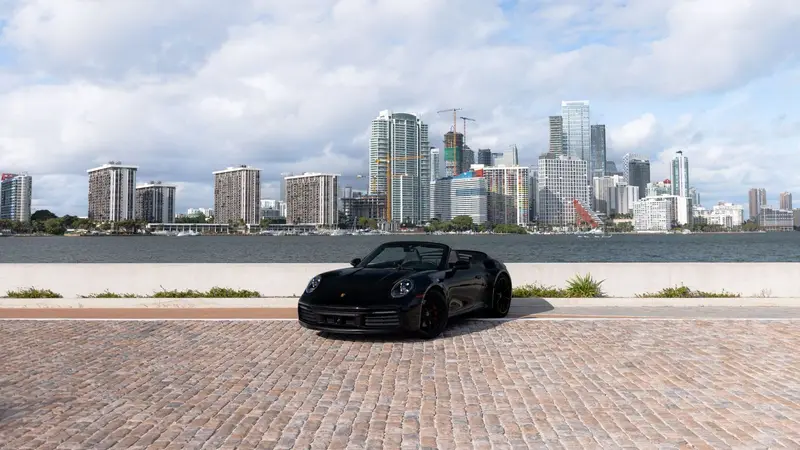
In practice, this means a supercar can be genuinely calm and livable cruising the MacArthur Causeway with the skyline glittering across the water, or rolling gently down Collins Avenue in traffic, soft and quiet and easy to place. Leave it in its comfort setting and it behaves. Then, when you find open, appropriate road and want the car to show a different side, you dial it up and it transforms into something sharper and more alert. Same car, two personalities, and you choose which one you want. The beauty is in that range, not in chasing a number.
Reality Check: Where This Performance Actually Lives
Let us be honest about something. The vast majority of a supercar's true capability is simply unusable on public roads, and that is completely fine. The top-speed figures, the maximum downforce, the outer edge of what the tires and brakes can do: reaching any of that safely requires a track and the space and controls that come with it. Chasing it on public streets is neither smart nor safe, and it misses the point.
The real value of these cars, the part you actually get to enjoy every single time, lives well within legal speeds. It is the sound of that V10 or V12 as you accelerate onto a causeway. It is the instant, satisfying response of the throttle. It is the way the steering talks to your hands, the way the car sits planted and confident, the presence it commands when you pull up to a restaurant on Ocean Drive or a hotel in Aventura. It is the feeling, not the number.
That is also why so many people choose to spend real time in one of these machines before they ever think about buying. Reading about power-to-weight and adaptive dampers and dual-clutch gearboxes is one thing. Feeling all of it work together, on a beautiful South Florida morning, is another entirely. The most direct way to understand everything in this guide is to actually drive it.
Experience the Engineering Yourself
Every concept we have covered stops being abstract the moment you are behind the wheel. The shove of torque, the crispness of a mid-engine turn-in, the way the exhaust changes character when you switch modes: these are things you feel, not things you memorize.
If you want to connect the theory to the drive, the sports car lineup is where most of this engineering lives. Naturally aspirated and turbocharged, mid-engine and front-engine, rear-drive and all-wheel drive: the full spectrum of philosophies we have discussed sits within one fleet, spanning brands from Audi and Porsche to Ferrari, Lamborghini, and McLaren. Whether you are curious about exotic car rental in Miami for a weekend or simply want to understand what a Lamborghini feels like from the driver's seat rather than the sidewalk, the range is there to explore at your own pace. No pressure, just an open invitation to feel the difference for yourself.
Frequently Asked Questions
What makes a car a "supercar" instead of just a fast car?
It is the integration, not the horsepower. A supercar is a system in which power-to-weight, purpose-built engineering, aerodynamics, materials, tires, and electronics all work together toward performance and response. A fast sedan might match a supercar's power figure, but it is built for comfort and daily usability rather than the tightly integrated, purpose-driven engineering that defines an exotic. Horsepower alone never tells the full story.
Is a naturally aspirated engine better than a turbocharged one?
Neither is objectively better. They are different philosophies. A naturally aspirated engine rewards you with linear delivery, a high, screaming redline, and an immediacy of throttle response that many enthusiasts adore. A turbocharged engine gives you strong torque lower in the rev range, effortless surges of acceleration, and better efficiency. The right answer is genuinely a matter of personal preference and what kind of experience moves you.
Why are supercars mostly mid-engine?
Placing the engine behind the driver concentrates the car's mass near its center, which improves balance and weight distribution. That makes the car more eager to change direction and gives it a crisper, more responsive feel through corners. It is a fundamental reason so many supercars feel so agile. That said, front-engine grand tourers still have a firm place. They trade some of that agility for a long-legged, comfortable character that excels at covering distance in style.
Do I need to drive fast to enjoy a supercar?
Not at all. The sound of the engine, the sharpness of the response, the feel of the steering, and the sheer presence of the car all deliver at completely legal, sensible speeds. Most of a supercar's outright capability is only accessible on a track anyway. The everyday joy of these cars lives well within the speed limit, in the experience of driving something special rather than in any top-speed figure.
What's the easiest way to actually experience a supercar in Miami?
Renting is the lowest-commitment way to feel the engineering firsthand, without the costs, depreciation, and maintenance of ownership. You get to spend real time in the car, in real conditions, and understand what all this theory feels like from the driver's seat. For most exotics, drivers need to be at least 18 with a valid license and active personal car insurance, and higher refundable deposits may apply for drivers 18 to 21. If you would rather skip the insurance question entirely, chauffeur service is available. Browse the fleet to see which cars and philosophies you would most like to experience.
From Curiosity to the Driver's Seat
So, how do supercars work? They work by making thousands of small engineering decisions all point in the same direction, then tying them together so tightly that the result feels less like machinery and more like instinct. The engine gives the car its voice. The lightweight materials and aerodynamics give it poise. The transmission, brakes, tires, and suspension give it precision. And the driving modes let one car be many things depending on the road and your mood.
You now understand what is happening under all that drama. The best way to complete that understanding is to feel it, on a beautiful South Florida drive, at your own pace and on your own terms.
When you are ready, explore the full Rushing Rentals fleet or dig into more explainers on the blog. Questions are always welcome. Call or WhatsApp us at (850) 218-5463, email info@rushingrentals.co, or follow along on Instagram at @rushingrentals. The engineering is remarkable on paper. It is unforgettable from the driver's seat.