The Sound of Speed: Why Supercars Sound So Good
It usually starts before you see the car. A Ferrari V12 clears its throat outside a South Beach hotel, and the valet line goes quiet for a second. An Audi R8 climbs Collins Avenue at dusk and the note bounces off the glass towers, rising as the driver rolls into the throttle. Duck into a parking structure off Ocean Drive and the same exhaust becomes something else entirely, layered and echoing off the concrete like a room built for it. In Miami, the soundtrack often arrives ahead of the machine.
So why do supercars sound so good? That is the question this piece answers, and we are going to answer it honestly. Not with marketing language, but with the actual physics and engineering behind the note: how cylinders create pulses, why a crankshaft can completely change a car's voice, and what separates the deep American rumble from the metallic wail of a race-bred V10. We spend most of our days around these engines here in South Florida, so consider this the insider's field guide to the sound rather than a sales pitch. By the end you will understand what you are hearing, and where in Miami it sounds its best.
How an Engine Finds Its Voice
At its core, the sound of any combustion engine comes from a single event repeated thousands of times a minute. Fuel and air ignite inside a cylinder, the resulting explosion pushes a piston down, and the spent gases exit through the exhaust as a sharp pulse of pressure. That pulse is the raw material of the sound. String enough of them together, at the right rhythm and spacing, and your ear stops hearing individual thuds and starts hearing a note.
Think of it in musical terms. Each pressure pulse is a beat. The engine's speed, measured in revolutions per minute, sets the tempo. At idle the beats are slow and separated, which is why you can often pick out an engine's character most clearly when it is just sitting there. Wind the engine toward its redline and those beats come so quickly they blur into a continuous tone. The pitch climbs with the tempo.
A handful of variables decide what that note actually sounds like:
- Cylinder count. A four-cylinder, a V8, and a V12 all produce different densities of pulses.
- Firing order and interval. The exact sequence and spacing in which the cylinders fire. Even spacing sounds smooth; uneven spacing sounds lumpy and syncopated.
- Engine speed. A car that revs to 6,000 rpm can never reach the pitch of one that spins to 9,000.
- Exhaust routing. The plumbing that carries and shapes those pulses on their way out.
As a general rule, more cylinders, higher revs, and carefully tuned exhaust routing push a car toward a more complex, higher, and richer note. But that rule has plenty of interesting exceptions, and the most interesting of all lives inside the V8.
The V8 and the Crankshaft That Changes Everything
The V8 is the engine most people picture when they think of an exotic or a muscle car. It is also the most fascinating one to study, because two V8s can share the same cylinder count and displacement and still sound like they were built on different planets. The reason comes down to a single component: the crankshaft.
The crankshaft is the spinning axle at the bottom of the engine that all the pistons connect to. As each piston is driven down by combustion, it turns the crank, and the crank's shape determines the exact moments each cylinder fires. Change the geometry of that crankshaft and you change the firing intervals. Change the firing intervals and you fundamentally change the voice of the engine. There are two dominant approaches, and they define two very different characters.
Cross-plane V8: the American burble
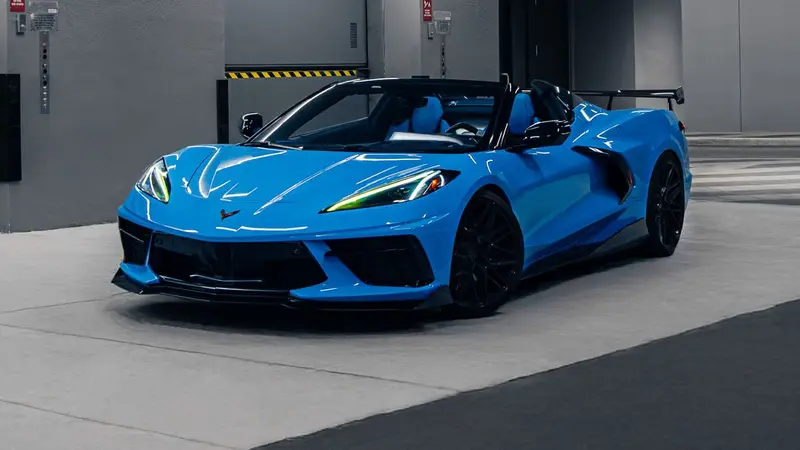
The cross-plane crankshaft arranges its connecting points at 90-degree intervals, which staggers the firing so that the two banks of cylinders do not fire evenly. That unevenness is the secret behind the sound most people associate with American V8s: a deep, offbeat, loping rumble that sounds almost lazy at idle and turns into a full-chested roar under throttle. You hear it in cars like the Corvette C8 3LT.
Describe it without the jargon and it is easy to picture. At a stoplight the engine settles into a low, muscular idle with a slight hitch to it, the sonic equivalent of a heavyweight rolling its shoulders. Open it up and that hitch smooths into a thunderous baritone. It is the sound of American performance, and for a lot of enthusiasts it is the first engine note they ever fell in love with.
Flat-plane V8: the race-derived wail
The flat-plane crankshaft arranges its points at 180-degree intervals, producing perfectly even firing across both banks. That even rhythm creates a completely different sound: higher, sharper, more metallic, closer to a scream than a rumble. This is the layout favored in race-derived engines, and it is the voice you hear in the flat-plane V8s from Ferrari and McLaren.
Where a cross-plane V8 loafs, a flat-plane V8 sounds urgent and alive, its note climbing with a hard-edged brightness as the revs rise. Worth noting, and we will come back to it: McLaren's flat-plane V8s are twin-turbocharged, which reshapes that raw wail in ways we will explore later. The point for now is that these are not better or worse than the cross-plane cars, just different personalities entirely. One is a rolling thunderstorm, the other is a race circuit on the street. Both are exactly what their makers intended.
The V10 Scream
If the V8 is a study in contrasts, the V10 occupies something close to a sonic sweet spot. With ten cylinders and firing intervals that fall between the character of a V8 and the density of a V12, it produces a note that is unmistakably metallic and pitched in that thrilling mid-to-high range. Add the fact that most exotic V10s are built to rev hard and long, and you get a sound that keeps climbing well past where most engines have run out of breath.
That climb is the magic of it. A V10 does not just make one great sound, it makes a whole arc of them as the tachometer sweeps upward. The note starts as a focused growl down low, tightens into a hard-edged blare through the midrange, and eventually opens into a soaring wail near redline. There is a reason the V10 developed such a devoted following among enthusiasts.
The two cars most people can actually get their ears on are close cousins. The Audi R8 Coupe V10 Plus and the Lamborghini Huracán share a naturally aspirated V10, meaning no turbochargers stand between the combustion and your ears. You can explore the full Lamborghini fleet to see the family it belongs to. Naturally aspirated matters here, because that direct, unmuffled path is a big part of why these engines sound so raw and immediate.
Picture the R8 opening up on an open stretch heading north out of the city, the pitch rising steadily through the rev range until the whole car seems to be singing. For anyone comparing a Lamborghini rental against a Ferrari rental in Miami on sound alone, the V10 is often the deciding factor. It splits the difference between rumble and scream, and it does it with a clarity that is genuinely hard to forget.
The V12 and Its Orchestra
Twelve cylinders change the conversation. Where a V8 has personality and a V10 has drama, a V12 has something closer to depth and complexity, the reason people so often reach for the word "orchestral" to describe it. That is not a marketing language. It is a direct result of the engineering.
Two things make the V12 special. The first is mechanical balance. With twelve cylinders arranged in two banks of six, the forces inside the engine cancel each other out almost perfectly, which is why a great V12 feels so smooth and sounds so refined even when it is working hard. The second is the sheer density of the firing pulses. Twelve cylinders firing in close, even succession pack far more pulses into every revolution than a V8 or V10, and at high rpm those pulses layer over one another into a rich, complex wall of sound. It is less like a single instrument and more like a section playing in unison.
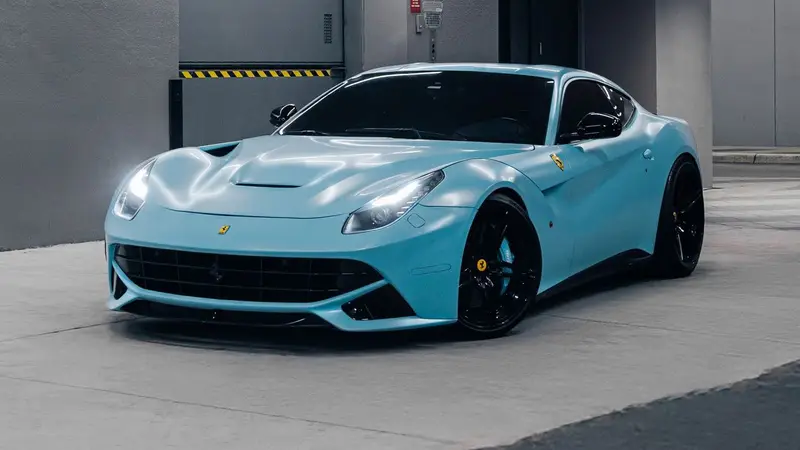
The car that captures this on our fleet is the Ferrari F12 Berlinetta, powered by a naturally aspirated V12. At low speeds it is composed, almost polite, hinting at what it is holding back. Wind it up and the note builds in layers, gaining density and complexity as the revs climb, until it fills the space around it in a way a smaller engine simply cannot replicate. Where a V8 gives you a clear, singular voice and a V10 gives you a soaring scream, the V12 gives you texture, a sound with more happening inside it.
None of this makes the V12 the "best" engine, and it would be dishonest to frame it that way. It is a specific character: rich, refined, and complex, with a smoothness that some love and others find almost too polished compared to the raw edge of a flat-plane V8. What is not in question is that a great V12 is one of the defining sounds in the automotive world, and hearing one properly is an experience that stays with you.
Beyond the Engine: Exhausts, Valves, and Deliberate Tuning
Here is the part that surprises people. The engine is only the starting instrument. The note you actually hear from a modern exotic is the product of extensive, deliberate engineering that happens after the combustion event. Engineers voice a car the way a luthier voices an instrument.
Consider the exhaust system itself. The length and diameter of the pipes, the design of the headers that collect gases from each cylinder, and the placement of chambers along the way all shape and filter the pulses on their journey out. Longer pipes, wider bores, and specific bends can emphasize certain frequencies and suppress others. Resonance tuning, the careful matching of exhaust geometry to the frequencies the engine produces, is used to amplify the parts of the note the engineers want you to hear and quiet the parts they do not. This is precise work, closer to acoustics than plumbing.
The most visible expression of this is the valved exhaust system, now common across performance cars. These systems place electronically controlled valves in the exhaust path that open and close depending on the drive mode. In a quiet mode the valves stay closed, routing gases through a longer, more muffled path for a civil, restrained sound suited to a residential street late at night. In a sport or track mode the valves open, giving the exhaust a shorter, freer path and unleashing the fuller, louder character. It is the same engine producing two very different personalities on command.
Layer on the effect of rpm and you understand just how much range a single car has. The same exhaust that murmurs at idle can howl at redline, because the frequency and intensity of the pulses change so dramatically across the rev range. The takeaway is that much of what enthusiasts love about exotic engine notes is not a happy accident. It is intentional acoustic engineering, tuned and refined by people who treat sound as a core part of the product.
That said, balance matters. Louder is not automatically better, and the most impressive exhaust note is not always the most aggressive one. A well-voiced car is one where the sound matches the character of the machine, whether that means a restrained rumble or a full-throated scream. It is a designed choice, and the good ones are designed with taste.
The Turbo and Electric Shift
Two modern developments are reshaping the soundscape, and both deserve an honest look rather than nostalgia or alarm.
The first is forced induction. A turbocharger sits in the exhaust stream and uses those very pressure pulses to spin a compressor, forcing more air into the engine. That process is fantastic for power, but it changes the sound. The turbo absorbs and smooths some of the sharp exhaust pulses on their way out, which tends to muffle the top-end shriek and give the engine a deeper, quieter, more muscular character. Many modern exotics are turbocharged, including McLaren's flat-plane V8s, which is why those cars sound different from a naturally aspirated V8 despite sharing the same crankshaft philosophy. It is not a loss so much as a different flavor, one with its own low-end urgency and whoosh.
The second development is electrification, and this is the one people worry about most. It is worth saying plainly: electric and hybrid supercars are not the end of sound, they are a new kind of sound. An electric motor produces instant torque and a rising whine that builds with speed, a futuristic tone with its own drama. Many manufacturers are now engineering deliberate soundscapes into their electric cars, shaping the acoustic experience the same way they once tuned an exhaust. And there is something to the quiet presence too, the sense of a car moving with immense force and almost no noise, which is a distinct kind of impact.
You can feel this new frontier in a car like the GMC Hummer EV, where the experience is defined by silent, effortless surge rather than exhaust theater. The honest verdict is that the soundscape is evolving, with real tradeoffs on both sides. The combustion note carries emotion and heritage that electric cars approach differently, while electric drivetrains offer an immediacy and calm that combustion cannot match. Neither cancels the other out. They coexist, and the enthusiast world is richer for having both.
Where to Hear It in South Florida
Understanding the theory is one thing. Feeling it is another, and Miami happens to be an exceptional place to feel it. Certain roads and moments bring out the best in an exotic engine, and knowing where to go is half the experience.
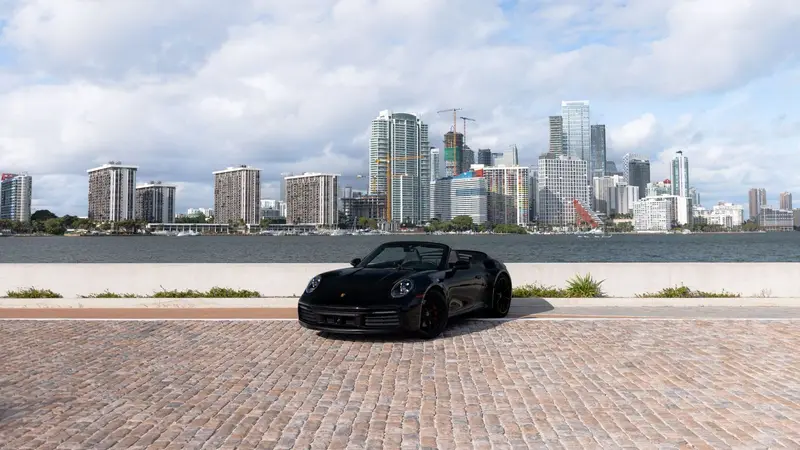
The causeways are the obvious starting point. The MacArthur and the Venetian both offer those open, uninterrupted stretches where a V12 has room to climb through the revs and show you what it can do, with water on both sides and nothing to absorb the sound. There is a reason you so often hear an exotic before you see it crossing the bay. For low-speed theater, Ocean Drive is unmatched, the place where a car rolls along at walking pace and the crowd turns to listen to the idle. Collins Avenue gives you that glass-canyon effect, the note reflecting off the towers as you move.
Then there are the accidental concert halls: the tunnels and parking structures scattered across the city, where concrete walls catch an exhaust note and throw it back at you amplified and layered. Plenty of enthusiasts will admit to taking the long way through a parking garage just to hear the car echo. These are the details that separate a good drive from a memorable one.
As a team based in Aventura and North Miami Beach, we spend a lot of time on these roads, and we have opinions about which routes make which cars sound their best. That local knowledge is part of what makes an exotic car rental in Miami more than just handing over a set of keys. Whether you are after a sports car rental in Miami for a weekend or simply want to understand what all the noise is about, the routes are as much a part of the experience as the machine. You can browse the sports cars to see the fleet that fits these drives.
Hear It for Yourself
For all the physics and engineering, the truth is that the sound of a supercar does not fully translate into words. You can read about firing intervals and flat-plane cranks and valved exhausts, but the only way to really understand a V12 is to stand near one as it climbs through the revs and feel the sound in your chest. Renting gives you exactly that, the full sensory experience without the cost, depreciation, and long-term commitment of ownership.
We have been doing this since 2020, and in that time we have put more than 750 clients behind the wheel of a fleet of 25-plus vehicles across three-plus locations in Aventura and North Miami Beach. We know the cars and we know the roads.
A quick note on logistics, since first-time renters always ask: the minimum age to rent is 18, and you will need a valid license and active personal car insurance. If you do not carry your own policy, our chauffeur service lets you enjoy the same cars and the same drives without it. Drivers between 18 and 21 may be subject to a higher refundable deposit. None of it is complicated once you know what to expect.
Browse the fleet or reach us at (850) 218-5463 to book the car whose sound you want to feel on the causeway. You can also email info@rushingrentals.co or find us on Instagram at @rushingrentals.
FAQ
Why do supercars sound so good compared to regular cars?
It comes down to several factors working together. Supercars tend to rev much higher than ordinary cars, which raises the pitch and intensity of the note. They often have more cylinders, which increases the density and complexity of the sound. Their exhaust systems are purpose-built and tuned for acoustic effect rather than simply for quiet. And they are designed with less sound insulation, so more of the engine's character reaches your ears. The short answer to why supercars sound so good is that everything about them, from the engine to the exhaust to the interior, is engineered to let the sound come through.
What is the difference between a flat-plane and cross-plane V8?
The difference is in the crankshaft geometry, which controls the firing intervals. A cross-plane V8 fires unevenly across its two cylinder banks, producing the deep, offbeat, loping rumble associated with American muscle. A flat-plane V8 fires evenly, producing a higher, sharper, more metallic wail associated with race-derived engines. Same cylinder count, completely different voices, and neither is superior. They are simply two different characters.
Why does a V12 sound different from a V10?
It is mostly about cylinder count, the spacing of the firing pulses, and mechanical balance. A V12 packs more pulses into each revolution and is exceptionally well balanced, which gives it a smooth, dense, layered sound at high rpm that many describe as orchestral. A V10 has fewer cylinders and a firing pattern that produces a sharper, more piercing scream that soars as the revs climb. Both are prized. They just deliver different experiences.
Do electric supercars sound bad?
Not bad, just different. Electric supercars produce a rising torque whine and instant power delivery that has its own kind of drama, and many manufacturers now engineer deliberate soundscapes into them. There is also something distinct about the quiet, effortless surge of a powerful electric car. It is a genuinely different experience from a combustion engine rather than a worse one, and the soundscape is evolving to include both.
Which exotic has the best sound?
There is no honest answer to that beyond personal taste. Some enthusiasts are devoted to the flat-plane V8 wail, others to the richness and complexity of a V12, and plenty love the deep American rumble of a cross-plane V8. Each has a loyal following for good reason. The best way to find your favorite is to hear several of them in person and let your own ears decide.
Can I hear these cars in Miami without buying one?
Yes, and that is exactly what renting is for. A rental lets you experience the sound and the drive firsthand, on real roads, without the cost or commitment of ownership. If you want to hear a V10 or a V12 for yourself on the causeway, Rushing Rentals can put you in the right car.